
Join Our JEE Preparation Group
Prep with like-minded aspirants; Get access to free daily tests and study material.
Sign in
Please select an account to continue using cracku.in
↓ →
Join Our JEE Preparation Group
Prep with like-minded aspirants; Get access to free daily tests and study material.
The number of solutions of $$\sin^7 x + \cos^7 x = 1$$, $$x \in [0, 4\pi]$$ is equal to
We need to find the number of solutions of $$\sin^7 x + \cos^7 x = 1$$ in $$[0, 4\pi]$$.
We know that for all real $$x$$, $$|\sin x| \leq 1$$ and $$|\cos x| \leq 1$$. Since the exponent 7 is odd, $$\sin^7 x$$ has the same sign as $$\sin x$$. For $$|t| \leq 1$$, we have $$|t|^7 \leq t^2$$ (since $$|t|^5 \leq 1$$).
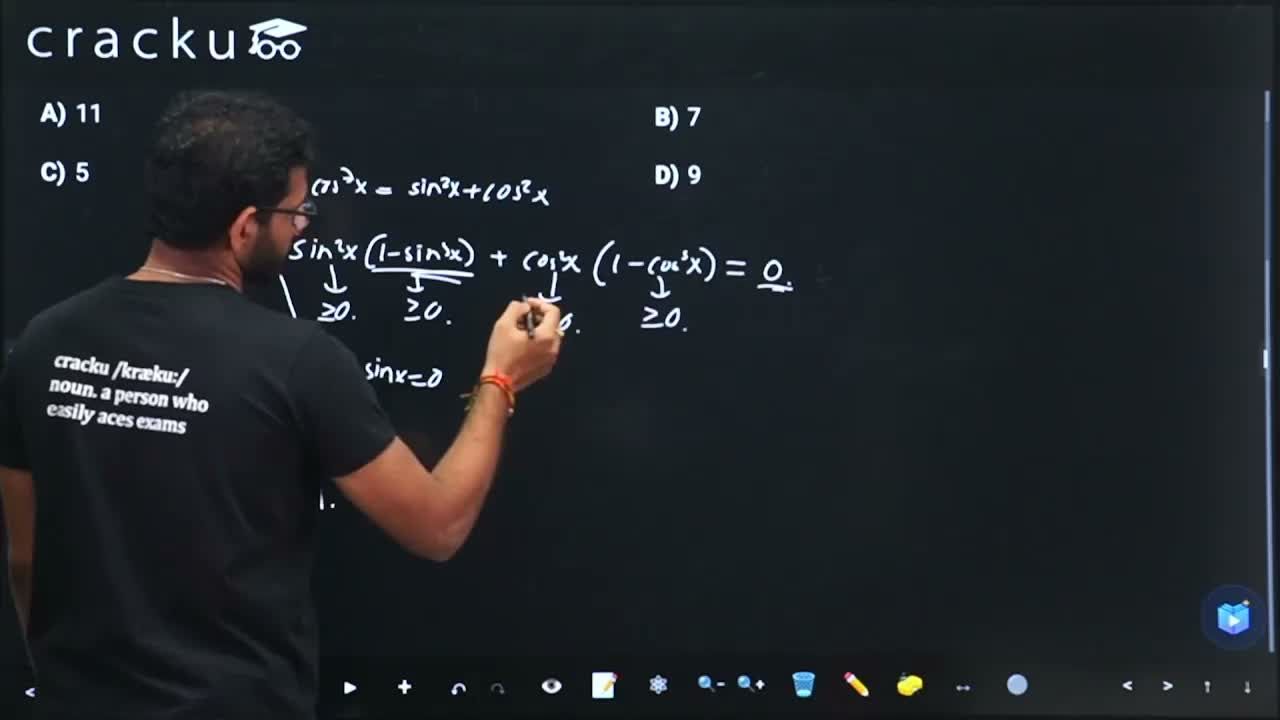
We can write: $$\sin^7 x + \cos^7 x = 1 = \sin^2 x + \cos^2 x$$, which gives $$(\sin^2 x - \sin^7 x) + (\cos^2 x - \cos^7 x) = 0$$, i.e., $$\sin^2 x(1 - \sin^5 x) + \cos^2 x(1 - \cos^5 x) = 0$$.
For any real $$x$$, if $$\sin x \geq 0$$ then $$\sin^5 x \leq 1$$ so the first term is $$\geq 0$$. If $$\sin x < 0$$ then $$\sin^5 x < 0$$ so $$1 - \sin^5 x > 1$$ and the first term is still $$> 0$$ (unless $$\sin x = 0$$). The same reasoning applies to the cosine term. Therefore each term is non-negative, and their sum can only be zero if each term is individually zero.
$$\sin^2 x(1 - \sin^5 x) = 0$$ gives $$\sin x = 0$$ or $$\sin x = 1$$.
$$\cos^2 x(1 - \cos^5 x) = 0$$ gives $$\cos x = 0$$ or $$\cos x = 1$$.
Case 1: $$\sin x = 0$$ and $$\cos x = 1$$, i.e., $$x = 2k\pi$$. In $$[0, 4\pi]$$: $$x = 0, 2\pi, 4\pi$$ — giving 3 solutions.
Case 2: $$\sin x = 1$$ and $$\cos x = 0$$, i.e., $$x = \frac{\pi}{2} + 2k\pi$$. In $$[0, 4\pi]$$: $$x = \frac{\pi}{2}, \frac{5\pi}{2}$$ — giving 2 solutions.
(The combinations $$\sin x = 0, \cos x = 0$$ and $$\sin x = 1, \cos x = 1$$ are both impossible.)
Total number of solutions = $$3 + 2 = 5$$.
The answer is $$5$$, which is Option C.
Click on the Email ☝️ to Watch the Video Solution
Create a FREE account and get:
_1.webp)

Educational materials for JEE preparation

Ask our AI anything

AI can make mistakes. Please verify important information.
AI can make mistakes. Please verify important information.


