
Join Our JEE Preparation Group
Prep with like-minded aspirants; Get access to free daily tests and study material.
Sign in
Please select an account to continue using cracku.in
↓ →
Join Our JEE Preparation Group
Prep with like-minded aspirants; Get access to free daily tests and study material.
If $$gcd(m, n) = 1$$ and $$1^2 - 2^2 + 3^2 - 4^2 + \ldots + (2021)^2 - (2022)^2 + (2023)^2 = 1012m^2n$$ then $$m^2 - n^2$$ is equal to
We need to evaluate $$1^2 - 2^2 + 3^2 - 4^2 + \cdots + (2021)^2 - (2022)^2 + (2023)^2$$.
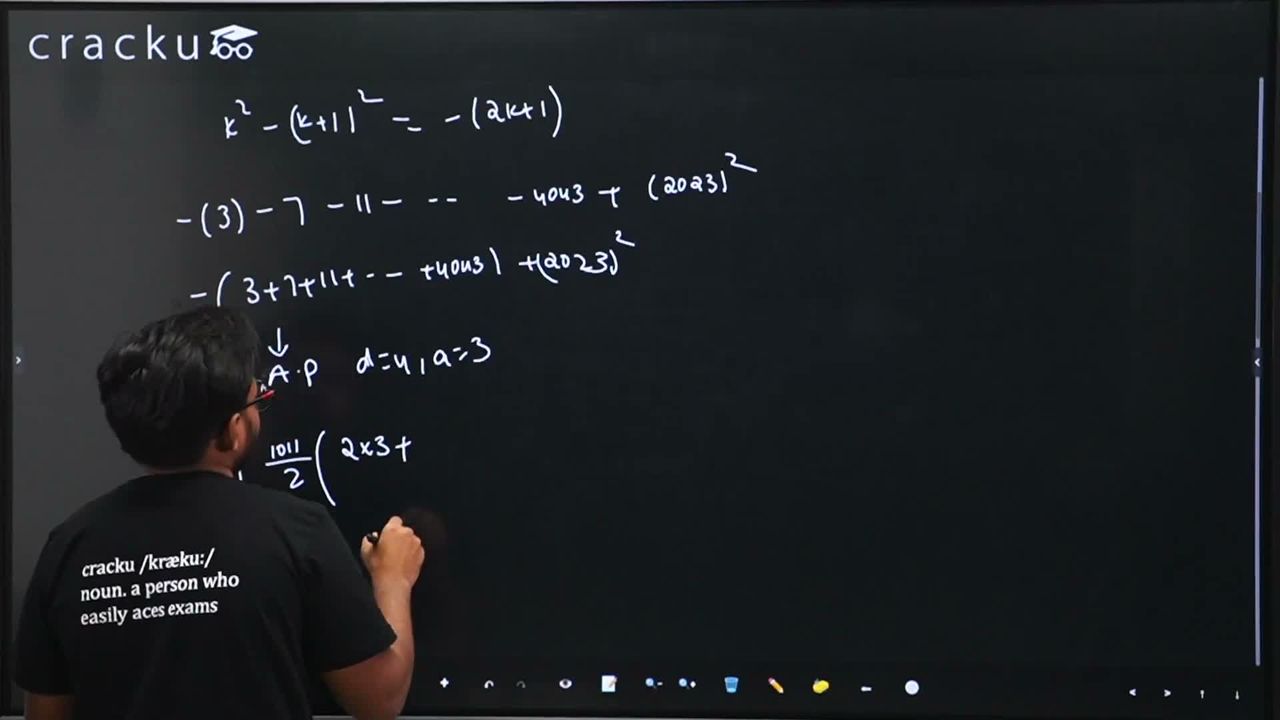
Pairing consecutive terms and using the identity $$k^2 - (k+1)^2 = -(2k+1)$$, we write the sum as:
$$(1^2 - 2^2) + (3^2 - 4^2) + \cdots + (2021^2 - 2022^2) + 2023^2$$
Each pair yields $$k^2 - (k+1)^2 = -(2k+1)$$ for $$k = 1, 3, 5, \ldots, 2021$$, so the values are $$-3, -7, -11, \ldots, -4043$$ and there are $$1011$$ such pairs.
Hence the sum of these pairs is $$-(3 + 7 + 11 + \cdots + 4043)$$, which is an arithmetic progression with first term 3, last term 4043, and 1011 terms, giving
$$= -\frac{1011}{2}(3 + 4043) = -1011 \times 2023$$
Adding the final term, we get
$$S = -1011 \times 2023 + 2023^2 = 2023(2023 - 1011) = 2023 \times 1012$$
Since $$S = 1012 \cdot m^2 \cdot n$$, it follows that $$m^2 n = 2023$$. Factoring 2023 gives $$2023 = 7 \times 17^2$$, and with $$\gcd(m, n) = 1$$ we have $$m = 17$$ and $$n = 7$$.
Therefore,
$$m^2 - n^2 = 289 - 49 = 240$$
The correct answer is Option A: 240.
Was this solution helpful?
Click on the Email ☝️ to Watch the Video Solution
Create a FREE account and get:
_1.webp)

Educational materials for JEE preparation

Ask our AI anything

AI can make mistakes. Please verify important information.
AI can make mistakes. Please verify important information.


