
Join Our JEE Preparation Group
Prep with like-minded aspirants; Get access to free daily tests and study material.
Sign in
Please select an account to continue using cracku.in
↓ →
Join Our JEE Preparation Group
Prep with like-minded aspirants; Get access to free daily tests and study material.
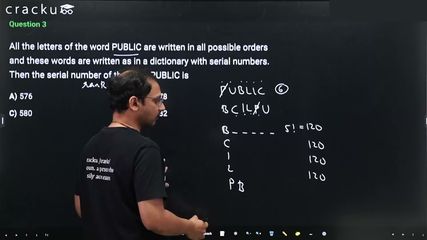
All the letters of the word PUBLIC are written in all possible orders and these words are written as in a dictionary with serial numbers. Then the serial number of the word PUBLIC is
We need to find the position of the word PUBLIC when all permutations of its letters are arranged in dictionary (alphabetical) order.
The letters of PUBLIC in alphabetical order are: B, C, I, L, P, U.
All 6 letters are distinct, so total arrangements = $$6! = 720$$.
To find the rank of P-U-B-L-I-C:
Position 1: P
Letters before P in the sorted list: B, C, I, L (4 letters).
Words starting with each = $$5! = 120$$.
Count = $$4 \times 120 = 480$$.
Position 2: U (remaining: B, C, I, L, U)
Letters before U: B, C, I, L (4 letters).
Words for each = $$4! = 24$$.
Count = $$4 \times 24 = 96$$.
Position 3: B (remaining: B, C, I, L)
Letters before B: none. Count = $$0$$.
Position 4: L (remaining: C, I, L)
Letters before L: C, I (2 letters).
Count = $$2 \times 2! = 4$$.
Position 5: I (remaining: C, I)
Letters before I: C (1 letter). Count = $$1 \times 1! = 1$$.
Position 6: C
Count = $$0$$.
Rank = $$480 + 96 + 0 + 4 + 1 + 0 + 1 = 582$$.
The correct answer is Option D: 582.
Was this solution helpful?
Click on the Email ☝️ to Watch the Video Solution
Create a FREE account and get:
_1.webp)

Educational materials for JEE preparation

Ask our AI anything

AI can make mistakes. Please verify important information.
AI can make mistakes. Please verify important information.


