
Join Our JEE Preparation Group
Prep with like-minded aspirants; Get access to free daily tests and study material.
Sign in
Please select an account to continue using cracku.in
↓ →
Join Our JEE Preparation Group
Prep with like-minded aspirants; Get access to free daily tests and study material.
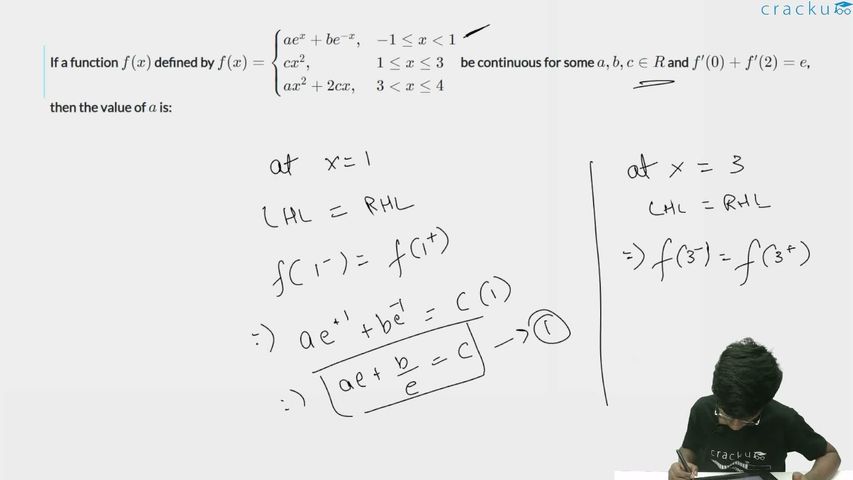
If a function $$f(x)$$ defined by $$f(x) = \begin{cases} ae^x + be^{-x}, & -1 \le x < 1 \\ cx^2, & 1 \le x \le 3 \\ ax^2 + 2cx, & 3 < x \le 4 \end{cases}$$ be continuous for some $$a, b, c \in R$$ and $$f'(0) + f'(2) = e$$, then the value of $$a$$ is:
We have the piece‐wise definition
$$f(x)=\begin{cases} ae^{x}+be^{-x}, & -1\le x<1\\[4pt] cx^{2}, & 1\le x\le3\\[4pt] ax^{2}+2cx, & 3<x\le4 \end{cases}$$
Because the question says that $$f(x)$$ is continuous everywhere in its domain, the left-hand and right-hand limits at the points where the rule changes must be equal to the actual function value. Thus we must impose continuity at $$x=1$$ and at $$x=3$$.
At $$x=1$$, the value coming from the first branch is
$$f(1^-)=ae^{1}+be^{-1}=ae+ \frac{b}{e}.$$
The value given by the second branch is
$$f(1^+)=c\,(1)^2=c.$$
Equating these two for continuity, we get
$$ae+\frac{b}{e}=c\qquad\qquad (1).$$
At $$x=3$$, the value from the second branch is
$$f(3^-)=c\,(3)^2=9c,$$
while the value from the third branch is
$$f(3^+)=a\,(3)^2+2c\,(3)=9a+6c.$$
Equality of these two expressions gives
$$9c=9a+6c.$$
Simplifying,
$$9c-6c=9a\;\;\Longrightarrow\;\;3c=9a\;\;\Longrightarrow\;\;c=3a\qquad\qquad (2).$$
Now we substitute $$c=3a$$ into equation (1):
$$ae+\frac{b}{e}=3a.$$
Isolating $$b$$, we write
$$\frac{b}{e}=3a-ae\;\;\Longrightarrow\;\;b=e\bigl(3a-ae\bigr)=ae(3-e)\qquad\qquad (3).$$
Next we turn to the derivative. For each interval we differentiate the corresponding expression.
• For $$-1<x<1$$ we have $$f(x)=ae^{x}+be^{-x}$$, so
$$f'(x)=ae^{x}-be^{-x}.$$
• For $$1<x<3$$ we have $$f(x)=cx^{2}$$, so
$$f'(x)=2cx.$$
• For $$3<x\le4$$ we have $$f(x)=ax^{2}+2cx$$, so
$$f'(x)=2ax+2c.$$
Therefore
$$f'(0)=ae^{0}-be^{0}=a-b,$$
because $$e^{0}=1.$$
Also, $$2$$ lies in the interval $$1\le x\le3,$$ so we use the middle derivative:
$$f'(2)=2c\,(2)=4c.$$
The problem tells us that
$$f'(0)+f'(2)=e.$$
Substituting the expressions just found,
$$(a-b)+4c=e.$$
Now we insert the relations (2) and (3): $$c=3a$$ and $$b=ae(3-e).$$
Thus
$$(a-ae(3-e))+4(3a)=e.$$
First combine like terms:
$$a-ae(3-e)+12a=e.$$
Notice that $$a+12a=13a,$$ so
$$13a-ae(3-e)=e.$$
Factor out $$a$$ from the left‐hand side:
$$a\bigl(13-e(3-e)\bigr)=e.$$
Now compute the bracket:
$$e(3-e)=3e-e^{2},$$
so
$$13-e(3-e)=13-(3e-e^{2})=13-3e+e^{2}=e^{2}-3e+13.$$
Hence we have
$$a\,(e^{2}-3e+13)=e.$$
Finally, solving for $$a$$ gives
$$a=\frac{e}{e^{2}-3e+13}.$$
This value matches Option D.
Hence, the correct answer is Option D.
Was this solution helpful?
Click on the Email ☝️ to Watch the Video Solution
Create a FREE account and get:
_1.webp)

Educational materials for JEE preparation

Ask our AI anything

AI can make mistakes. Please verify important information.
AI can make mistakes. Please verify important information.
