
Join Our JEE Preparation Group
Prep with like-minded aspirants; Get access to free daily tests and study material.
Sign in
Please select an account to continue using cracku.in
↓ →
Join Our JEE Preparation Group
Prep with like-minded aspirants; Get access to free daily tests and study material.
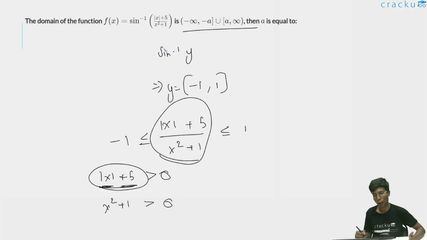
The domain of the function $$f(x) = \sin^{-1}\left(\frac{|x|+5}{x^2+1}\right)$$ is $$(-\infty, -a] \cup [a, \infty)$$, then $$a$$ is equal to:
We begin with the real-valued condition for an inverse sine. For any expression $$\sin^{-1}(y)$$ to be defined, the quantity inside the inverse sine must satisfy the inequality
$$-1 \;\le\; y \;\le\; 1.$$
In our problem the “$$y$$” is
$$y \;=\; \dfrac{|x|+5}{x^{2}+1}.$$
Observe first that $$|x|+5 \ge 0$$ and $$x^{2}+1 \gt 0$$ for every real $$x$$. Therefore
$$\dfrac{|x|+5}{x^{2}+1} \ge 0,$$
so the left-hand bound $$-1 \le y$$ is automatically satisfied. We only need to impose the right-hand bound
$$\dfrac{|x|+5}{x^{2}+1} \le 1.$$
Multiplying both sides by the positive denominator $$x^{2}+1$$ (this does not change the direction of the inequality) we get
$$|x| + 5 \;\le\; x^{2} + 1.$$
Now we bring every term to the right in order to compare with zero:
$$0 \;\le\; x^{2} + 1 - |x| - 5.$$
Simplifying the constants gives
$$0 \;\le\; x^{2} - |x| - 4.$$
Because of the absolute value, it is convenient to introduce a non-negative variable
$$t \;=\; |x| \quad\text{with}\quad t \ge 0.$$
Since $$x^{2} = (|x|)^{2} = t^{2},$$ the inequality becomes
$$0 \;\le\; t^{2} - t - 4.$$
We now solve the quadratic inequality. First, we find its roots using the quadratic formula. For $$t^{2} - t - 4 = 0$$ we have
$$t \;=\; \dfrac{1 \pm \sqrt{\,1^{2} - 4\,(1)(-4)\,}}{2} \;=\; \dfrac{1 \pm \sqrt{1 + 16}}{2} \;=\; \dfrac{1 \pm \sqrt{17}}{2}.$$
This gives two real roots
$$t_{1} = \dfrac{1 + \sqrt{17}}{2}, \qquad t_{2} = \dfrac{1 - \sqrt{17}}{2}.$$
The second root $$t_{2}$$ is negative because $$\sqrt{17} \gt 1,$$ but we already have $$t \ge 0,$$ so $$t_{2}$$ is irrelevant. The quadratic $$t^{2} - t - 4$$ opens upward (positive leading coefficient). Hence it is non-negative for
$$t \;\ge\; \dfrac{1 + \sqrt{17}}{2}.$$
Returning to $$t = |x|,$$ we translate this result back to $$x.$$ The inequality
$$|x| \;\ge\; \dfrac{1 + \sqrt{17}}{2}$$
is equivalent to the pair of intervals
$$x \;\le\; -\,\dfrac{1 + \sqrt{17}}{2} \quad\text{or}\quad x \;\ge\; \dfrac{1 + \sqrt{17}}{2}.$$
Therefore the domain of $$f(x)$$ is
$$(-\infty,\;-\dfrac{1 + \sqrt{17}}{2}] \;\cup\; [\dfrac{1 + \sqrt{17}}{2},\;\infty).$$
Comparing with the form $$(-\infty, -a] \cup [a, \infty)$$ we identify
$$a \;=\; \dfrac{1 + \sqrt{17}}{2}.$$
Among the given choices, this value corresponds to Option C.
Hence, the correct answer is Option C.
Was this solution helpful?
Click on the Email ☝️ to Watch the Video Solution
Create a FREE account and get:
_1.webp)

Educational materials for JEE preparation

Ask our AI anything

AI can make mistakes. Please verify important information.
AI can make mistakes. Please verify important information.
