
Join Our JEE Preparation Group
Prep with like-minded aspirants; Get access to free daily tests and study material.
Sign in
Please select an account to continue using cracku.in
↓ →
Join Our JEE Preparation Group
Prep with like-minded aspirants; Get access to free daily tests and study material.
If $$2\sin^3 x + \sin 2x \cos x + 4\sin x - 4 = 0$$ has exactly $$3$$ solutions in the interval $$\left[0, \frac{n\pi}{2}\right]$$, $$n \in \mathbb{N}$$, then the roots of the equation $$x^2 + nx + (n - 3) = 0$$ belong to :
Step 1: Simplifying the Trigonometric Equation
The original equation is:
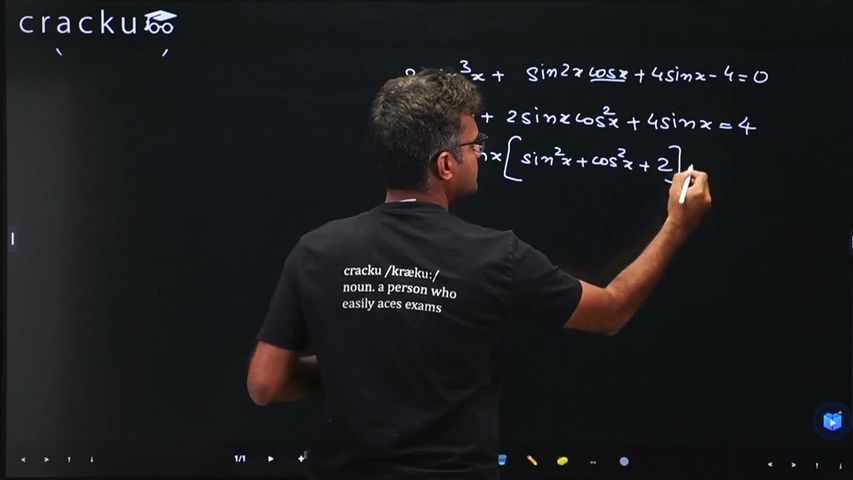
$$2 \sin^3 x + \sin 2x \cos x + 4 \sin x - 4 = 0$$
First, expand the $$\sin 2x$$ term using the identity $$\sin 2x = 2 \sin x \cos x$$:
$$2 \sin^3 x + (2 \sin x \cos x) \cos x + 4 \sin x = 4$$
$$2 \sin^3 x + 2 \sin x \cos^2 x + 4 \sin x = 4$$
Next, factor out $$2 \sin x$$ from the first two terms:
$$2 \sin x (\sin^2 x + \cos^2 x) + 4 \sin x = 4$$
Apply the fundamental trigonometric identity $$\sin^2 x + \cos^2 x = 1$$:
$$2 \sin x (1) + 4 \sin x = 4$$
$$6 \sin x = 4$$
$$\sin x = \frac{2}{3}$$
Step 2: Quadrant Analysis to find n
$$\sin x$$ is a positive value (+ve). Therefore, the solutions will lie in the first and second quadrants of the trigonometric circle.
The problem states there are exactly 3 solutions in the interval $$[0, \frac{n\pi}{2}]$$. To encompass exactly the first three roots and no more, the upper limit of the interval must be $$\frac{5\pi}{2}$$.
By equating $$\frac{n\pi}{2}$$ to $$\frac{5\pi}{2}$$, we determine that $$n = 5$$.
Step 3: Solving the Quadratic Equation
Substitute $$n = 5$$ into the given polynomial $$x^2 + nx + (n - 3) = 0$$:
$$x^2 + 5x + (5 - 3) = 0$$
$$x^2 + 5x + 2 = 0$$
Apply the quadratic formula to find the roots:
$$x = \frac{-5 \pm \sqrt{5^2 - 4(1)(2)}}{2}$$
$$x = \frac{-5 \pm \sqrt{25 - 8}}{2}$$
$$x = \frac{-5 \pm \sqrt{17}}{2}$$
Step 4: Finding the correct interval
We know that $$\sqrt{16} < \sqrt{17} < \sqrt{25}$$, so the value of $$\sqrt{17}$$ is slightly greater than $$4$$ (approximately $$4.12$$).
This means both mathematical roots will evaluate to negative numbers:
Because both roots are strictly negative, they belong entirely to the interval of negative real numbers, which is $$(-\infty, 0)$$.
Was this solution helpful?
Click on the Email ☝️ to Watch the Video Solution
Create a FREE account and get:
_1.webp)

Educational materials for JEE preparation

Ask our AI anything

AI can make mistakes. Please verify important information.
AI can make mistakes. Please verify important information.
