
Join Our JEE Preparation Group
Prep with like-minded aspirants; Get access to free daily tests and study material.
Sign in
Please select an account to continue using cracku.in
↓ →
Join Our JEE Preparation Group
Prep with like-minded aspirants; Get access to free daily tests and study material.
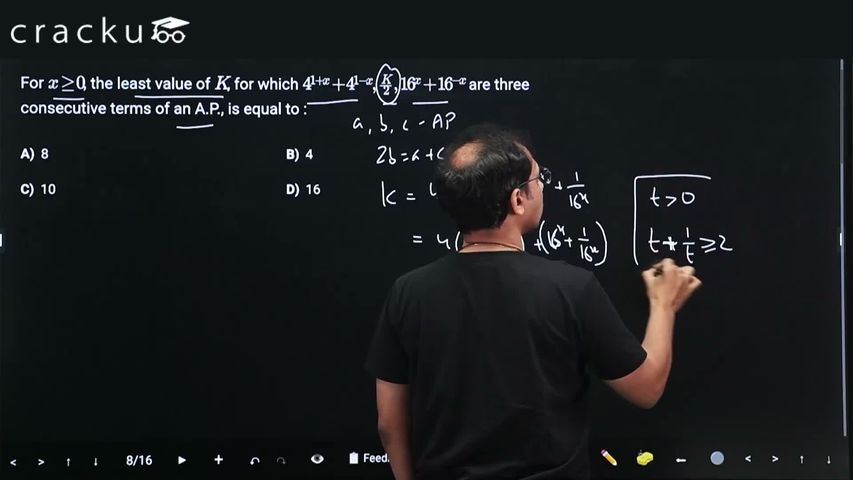
For $$x \geq 0$$, the least value of $$K$$, for which $$4^{1+x} + 4^{1-x}, \frac{K}{2}, 16^x + 16^{-x}$$ are three consecutive terms of an A.P., is equal to :
For three terms $$a, b, c$$ to be in an Arithmetic Progression (A.P.), they must satisfy the condition $$2b = a + c$$.
Applying this to our given terms:
$$2\left(\frac{K}{2}\right) = (4^{1+x} + 4^{1-x}) + (16^x + 16^{-x})$$
$$K = 4(4^x) + \frac{4}{4^x} + (4^x)^2 + \frac{1}{(4^x)^2}$$
To make this easier to analyze, let's substitute $$t = 4^x$$.
Since we are given $$x \ge 0$$, we know that $$4^x \ge 4^0$$. Therefore, $$t \ge 1$$.
Now, rewrite $$K$$ in terms of $$t$$:
$$K = 4\left(t + \frac{1}{t}\right) + \left(t^2 + \frac{1}{t^2}\right)$$
We can express the squared bracket in terms of $$\left(t + \frac{1}{t}\right)$$ using the identity $$a^2 + b^2 = (a+b)^2 - 2ab$$:
$$t^2 + \frac{1}{t^2} = \left(t + \frac{1}{t}\right)^2 - 2(t)\left(\frac{1}{t}\right) = \left(t + \frac{1}{t}\right)^2 - 2$$
Substitute this back into the equation for $$K$$:
$$K = 4\left(t + \frac{1}{t}\right) + \left(t + \frac{1}{t}\right)^2 - 2$$
Let's introduce a second substitution, $$y = t + \frac{1}{t}$$.
For $$t \ge 1$$, the function $$y = t + \frac{1}{t}$$ is strictly increasing. You can verify this using derivatives, or just logically: as $$t$$ grows larger than 1, the $$t$$ term dominates and the sum increases.
Thus, the minimum value of $$y$$ occurs at the boundary $$t = 1$$, giving $$y \ge 1 + 1 = 2$$.
Now, rewrite $$K$$ as a quadratic function of $$y$$:
$$K(y) = y^2 + 4y - 2$$
This represents an upward-opening parabola with its vertex at $$y = -2$$. However, our domain is strictly $$y \ge 2$$. On this interval, the quadratic is strictly increasing.
Therefore, the least value of $$K$$ must occur at the lowest possible value of $$y$$, which is $$y = 2$$ (this corresponds to $$x = 0$$).
Substitute $$y = 2$$ to find the least value of $$K$$:
$$K_{least} = (2)^2 + 4(2) - 2$$
$$K_{least} = 4 + 8 - 2 = 10$$
Was this solution helpful?
Click on the Email ☝️ to Watch the Video Solution
Create a FREE account and get:
_1.webp)

Educational materials for JEE preparation

Ask our AI anything

AI can make mistakes. Please verify important information.
AI can make mistakes. Please verify important information.
