
Join Our JEE Preparation Group
Prep with like-minded aspirants; Get access to free daily tests and study material.
Sign in
Please select an account to continue using cracku.in
↓ →
Join Our JEE Preparation Group
Prep with like-minded aspirants; Get access to free daily tests and study material.
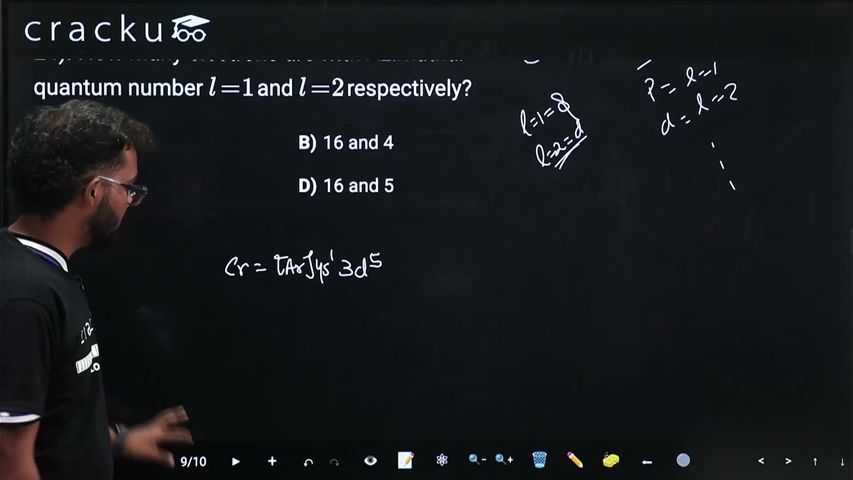
Consider the ground state of chromium atom (Z = 24). How many electrons are with Azimuthal quantum number $$l = 1$$ and $$l = 2$$ respectively?
The azimuthal quantum number $$l$$ decides the subshell:
$$l = 0 \;(\text{s}), \; l = 1 \;(\text{p}), \; l = 2 \;(\text{d}), \; l = 3 \;(\text{f})$$
The ground-state electronic configuration of a chromium atom ($$Z = 24$$) is exceptional. Instead of the expected $$3d^4\,4s^2$$, chromium attains extra stability with the half-filled $$3d$$ subshell:
$$\text{Cr} : [\text{Ar}]\,3d^{5}\,4s^{1}$$
Expand the configuration to list all occupied subshells:
$$1s^{2}\;2s^{2}\;2p^{6}\;3s^{2}\;3p^{6}\;3d^{5}\;4s^{1}$$
Case 1: Electrons with $$l = 1$$ (p-electrons)
The $$p$$ subshells present are $$2p^{6}$$ and $$3p^{6}$$.
Total $$p$$-electrons $$= 6 + 6 = 12$$.
Case 2: Electrons with $$l = 2$$ (d-electrons)
The only $$d$$ subshell present is $$3d^{5}$$.
Total $$d$$-electrons $$= 5$$.
Hence, in the ground state of chromium, the numbers of electrons with $$l = 1$$ and $$l = 2$$ are $$12$$ and $$5$$ respectively.
Therefore the correct option is Option C.
Was this solution helpful?
Click on the Email ☝️ to Watch the Video Solution
Create a FREE account and get:
_1.webp)

Educational materials for JEE preparation

Ask our AI anything

AI can make mistakes. Please verify important information.
AI can make mistakes. Please verify important information.
