
Join Our JEE Preparation Group
Prep with like-minded aspirants; Get access to free daily tests and study material.
Sign in
Please select an account to continue using cracku.in
↓ →
Join Our JEE Preparation Group
Prep with like-minded aspirants; Get access to free daily tests and study material.
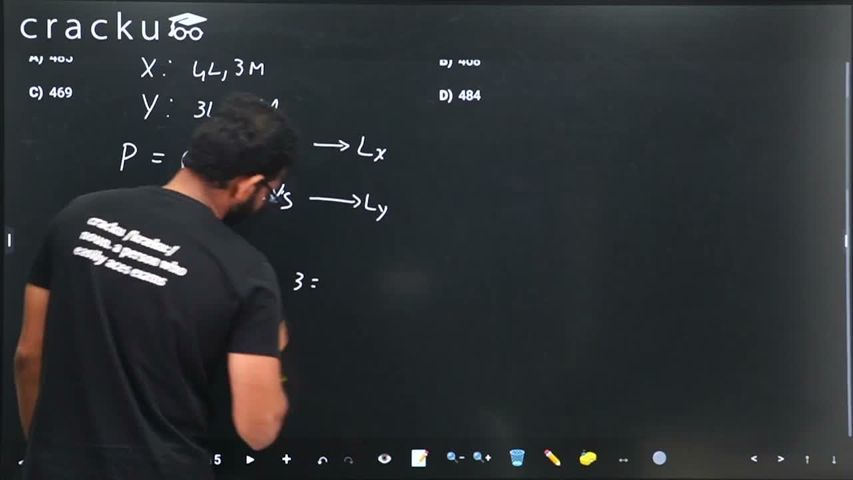
A man $$X$$ has 7 friends, 4 of them are ladies and 3 are men. His wife $$Y$$ also has 7 friends, 3 of them are ladies and 4 are men. Assume $$X$$ and $$Y$$ have no common friends. Then the total number of ways in which $$X$$ and $$Y$$ together can throw a party inviting 3 ladies and 3 men, so that 3 friends of each of $$X$$ and $$Y$$ are in this party is:
We begin by noting the exact data given in the statement. Man $$X$$ has $$7$$ friends, split as $$4$$ ladies and $$3$$ men. His wife $$Y$$ also has $$7$$ friends, split as $$3$$ ladies and $$4$$ men. It is clearly stated that there is no common friend between the two sets, so a person cannot be a friend of both $$X$$ and $$Y$$.
For the party we must invite exactly $$6$$ people in all - specifically $$3$$ ladies and $$3$$ men - and, in addition, exactly $$3$$ of the six must be friends of $$X$$ while the remaining $$3$$ must be friends of $$Y$$. Thus each of the couple contributes precisely three of his / her own friends to the guest list.
Let us describe the composition of the three friends chosen from each side. Put
$$L_X=\text{number of ladies chosen from }X\text{'s friends},$$ $$L_Y=\text{number of ladies chosen from }Y\text{'s friends}.$$
Because each of them contributes exactly three friends, the number of men chosen from $$X$$’s friends is $$3-L_X$$ and the number of men chosen from $$Y$$’s friends is $$3-L_Y$$.
Since the total number of ladies invited must be $$3$$, we have the key equation
$$L_X+L_Y=3.$$
Each of $$L_X$$ and $$L_Y$$ can range from $$0$$ to $$3$$, subject to the supplies of ladies each one actually has (remember $$X$$ has $$4$$ available ladies, $$Y$$ has $$3$$). The admissible ordered pairs $$\bigl(L_X,L_Y\bigr)$$ satisfying the equation are therefore:
$$\begin{aligned} &(0,3),\\ &(1,2),\\ &(2,1),\\ &(3,0). \end{aligned}$$
For every such pair we now compute how many ways the selections can be made. Throughout, we use the standard combination formula, stated here for clarity:
$$\binom{n}{r}=\dfrac{n!}{r!(n-r)!},$$
which counts the number of ways to choose $$r$$ objects from $$n$$ distinct objects without regard to order.
We evaluate case by case.
Case $$(L_X,L_Y)=(0,3)$$
$$X: \binom{4}{0}\times\binom{3}{3}=1\times1=1,$$ $$Y: \binom{3}{3}\times\binom{4}{0}=1\times1=1,$$ so the total for this case is $$1\times1=1.$$
Case $$(L_X,L_Y)=(1,2)$$
$$X: \binom{4}{1}\times\binom{3}{2}=4\times3=12,$$ $$Y: \binom{3}{2}\times\binom{4}{1}=3\times4=12,$$ and therefore the total here is $$12\times12=144.$$
Case $$(L_X,L_Y)=(2,1)$$
$$X: \binom{4}{2}\times\binom{3}{1}=6\times3=18,$$ $$Y: \binom{3}{1}\times\binom{4}{2}=3\times6=18,$$ giving $$18\times18=324$$ ways for this pattern.
Case $$(L_X,L_Y)=(3,0)$$
$$X: \binom{4}{3}\times\binom{3}{0}=4\times1=4,$$ $$Y: \binom{3}{0}\times\binom{4}{3}=1\times4=4,$$ so the count for this case is $$4\times4=16.$$
Finally, we add all the mutually exclusive cases:
$$1+144+324+16 = 485.$$
Hence, the correct answer is Option A.
Was this solution helpful?
Click on the Email ☝️ to Watch the Video Solution
Create a FREE account and get:
_1.webp)

Educational materials for JEE preparation

Ask our AI anything

AI can make mistakes. Please verify important information.
AI can make mistakes. Please verify important information.
