
Join Our JEE Preparation Group
Prep with like-minded aspirants; Get access to free daily tests and study material.
Sign in
Please select an account to continue using cracku.in
↓ →
Join Our JEE Preparation Group
Prep with like-minded aspirants; Get access to free daily tests and study material.
The number of ways five alphabets can be chosen from the alphabets of the word MATHEMATICS, where the chosen alphabets are not necessarily distinct, is equal to :
We need to find the number of ways to choose 5 alphabets from the word MATHEMATICS (not necessarily distinct).
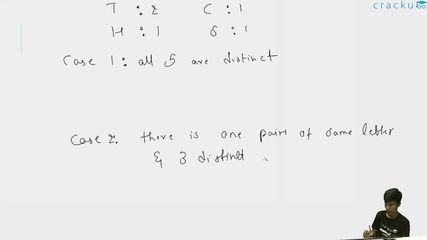
The distinct letters in MATHEMATICS with their frequencies are:
M: 2, A: 2, T: 2, H: 1, E: 1, I: 1, C: 1, S: 1
So we have 8 distinct letters, with 3 letters (M, A, T) appearing twice and 5 letters (H, E, I, C, S) appearing once.
We need to choose 5 letters where the chosen set respects the available multiplicities. We consider cases based on the pattern of repetitions.
Case 1: All 5 distinct.
Choose 5 from 8 distinct letters: $$\binom{8}{5} = 56$$.
Case 2: One pair + 3 distinct.
Choose which letter is repeated (from M, A, T): $$\binom{3}{1} = 3$$ ways.
Choose remaining 3 distinct letters from the other 7: $$\binom{7}{3} = 35$$ ways.
Total: $$3 \times 35 = 105$$.
Case 3: Two pairs + 1 distinct.
Choose 2 letters to be repeated (from M, A, T): $$\binom{3}{2} = 3$$ ways.
Choose 1 distinct letter from the remaining 6: $$\binom{6}{1} = 6$$ ways.
Total: $$3 \times 6 = 18$$.
Case 4: Three or more of the same letter.
Not possible since no letter appears more than twice.
Grand total = $$56 + 105 + 18 = 179$$.
The correct answer is Option 1: 179.
Was this solution helpful?
Click on the Email ☝️ to Watch the Video Solution
Create a FREE account and get:
_1.webp)

Educational materials for JEE preparation

Ask our AI anything

AI can make mistakes. Please verify important information.
AI can make mistakes. Please verify important information.
