
Join Our JEE Preparation Group
Prep with like-minded aspirants; Get access to free daily tests and study material.
Sign in
Please select an account to continue using cracku.in
↓ →
Join Our JEE Preparation Group
Prep with like-minded aspirants; Get access to free daily tests and study material.
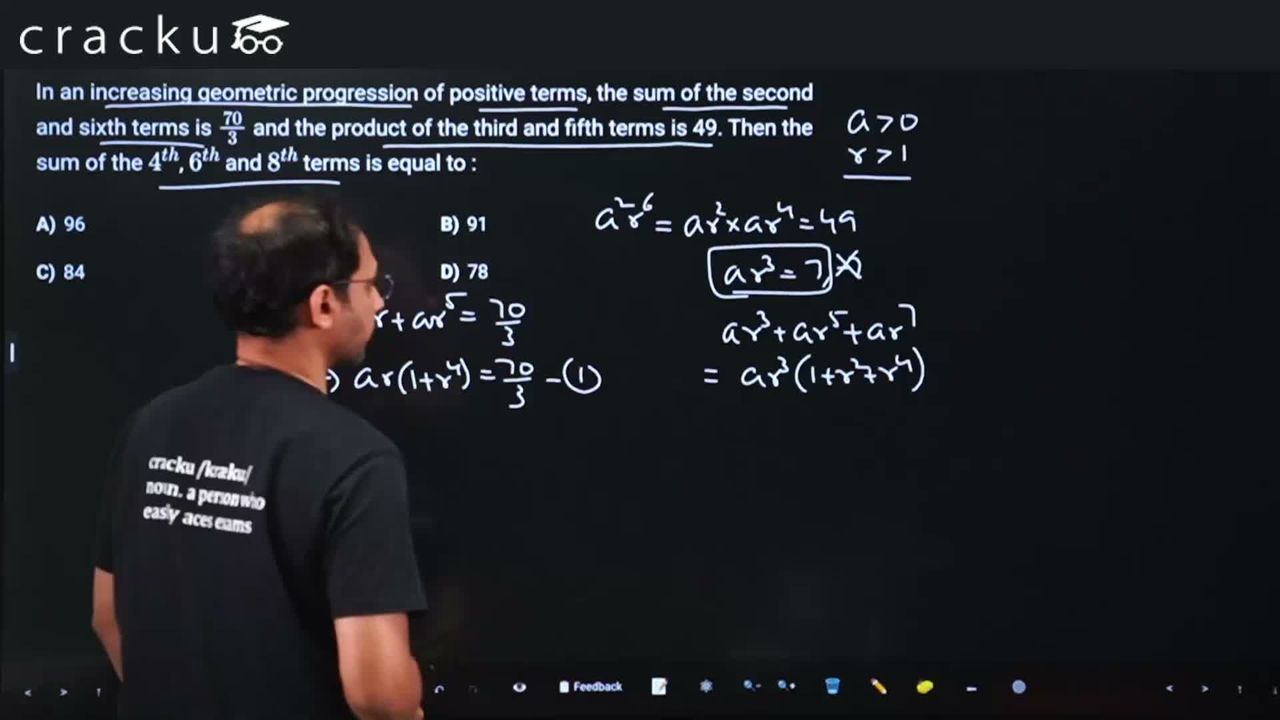
In an increasing geometric progression of positive terms, the sum of the second and sixth terms is $$\frac{70}{3}$$ and the product of the third and fifth terms is 49. Then the sum of the $$4^{th}$$, $$6^{th}$$ and $$8^{th}$$ terms is equal to :
Let the first term be $$a$$ and the common ratio be $$r$$. Since it's an increasing G.P. with positive terms, we know $$a > 0$$ and $$r > 1$$.
1. Use the product condition first:
We are given the product of the 3rd and 5th terms:
$$t_3 \cdot t_5 = 49$$
$$(ar^2)(ar^4) = a^2r^6 = 49$$
Taking the square root (ignoring the negative root since terms are positive):
$$ar^3 = 7$$
2. Use the sum condition:
We are given the sum of the 2nd and 6th terms:
$$t_2 + t_6 = \frac{70}{3}$$
$$ar + ar^5 = \frac{70}{3}$$
Factor out $$ar$$:
$$ar(1 + r^4) = \frac{70}{3}$$
Now, substitute $$a = \frac{7}{r^3}$$ from our first step into this equation:
$$\left(\frac{7}{r^3}\right) r (1 + r^4) = \frac{70}{3}$$
$$\frac{7}{r^2}(1 + r^4) = \frac{70}{3}$$
Divide both sides by 7 and separate the fraction:
$$\frac{1 + r^4}{r^2} = \frac{10}{3}$$
$$\frac{1}{r^2} + r^2 = \frac{10}{3}$$
3. Solve for $$r$$:
Let $$x = r^2$$. The equation becomes a standard quadratic form:
$$x + \frac{1}{x} = \frac{10}{3}$$
$$3x^2 - 10x + 3 = 0$$
Factorize the quadratic:
$$3x^2 - 9x - x + 3 = 0$$
$$3x(x - 3) - 1(x - 3) = 0$$
$$(3x - 1)(x - 3) = 0$$
So, $$x = 3$$ or $$x = 1/3$$. This means $$r^2 = 3$$ or $$r^2 = 1/3$$.
Since the G.P. is strictly increasing and terms are positive, $$r > 1$$, which implies $$r^2$$ must be greater than 1. Therefore, we select $$r^2 = 3$$.
4. Calculate the required sum:
We need to find the sum of the 4th, 6th, and 8th terms:
$$\text{Sum} = t_4 + t_6 + t_8$$
$$\text{Sum} = ar^3 + ar^5 + ar^7$$
Pull out $$ar^3$$ as a common factor:
$$\text{Sum} = ar^3(1 + r^2 + r^4)$$
We already calculated everything we need to plug in here: $$ar^3 = 7$$, $$r^2 = 3$$, and $$r^4 = (3)^2 = 9$$.
$$\text{Sum} = 7(1 + 3 + 9)$$
$$\text{Sum} = 7(13) = 91$$
Was this solution helpful?
Click on the Email ☝️ to Watch the Video Solution
Create a FREE account and get:
_1.webp)

Educational materials for JEE preparation

Ask our AI anything

AI can make mistakes. Please verify important information.
AI can make mistakes. Please verify important information.
