
Join Our JEE Preparation Group
Prep with like-minded aspirants; Get access to free daily tests and study material.
Sign in
Please select an account to continue using cracku.in
↓ →
Join Our JEE Preparation Group
Prep with like-minded aspirants; Get access to free daily tests and study material.
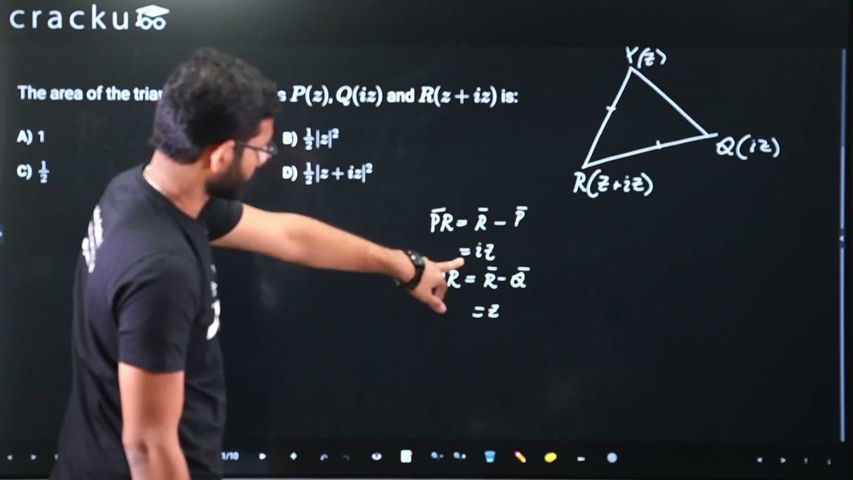
We are given three vertices in the complex plane: $$P(z)$$, $$Q(iz)$$, and $$R(z + iz)$$.
Let us observe the relationship between these points. The vector from $$P$$ to $$R$$ is $$R - P = (z + iz) - z = iz$$. The vector from $$Q$$ to $$R$$ is $$R - Q = (z + iz) - iz = z$$.
Notice that $$\overrightarrow{PR} = iz$$ and $$\overrightarrow{QR} = z$$. Multiplying $$z$$ by $$i$$ rotates it by $$90°$$ in the complex plane, so $$iz \perp z$$. This means $$PR \perp QR$$, and the triangle is right-angled at $$R$$.
The two sides meeting at the right angle have lengths $$|PR| = |iz| = |z|$$ and $$|QR| = |z|$$.
For a right triangle, the area is $$\frac{1}{2} \times \text{base} \times \text{height}$$. Here both legs equal $$|z|$$, so the area is $$\frac{1}{2} \times |z| \times |z| = \frac{1}{2}|z|^2$$.
This matches Option B: $$\frac{1}{2}|z|^2$$.
Was this solution helpful?
Click on the Email ☝️ to Watch the Video Solution
Create a FREE account and get:
_1.webp)

Educational materials for JEE preparation

Ask our AI anything

AI can make mistakes. Please verify important information.
AI can make mistakes. Please verify important information.
