
Join Our JEE Preparation Group
Prep with like-minded aspirants; Get access to free daily tests and study material.
Sign in
Please select an account to continue using cracku.in
↓ →
Join Our JEE Preparation Group
Prep with like-minded aspirants; Get access to free daily tests and study material.
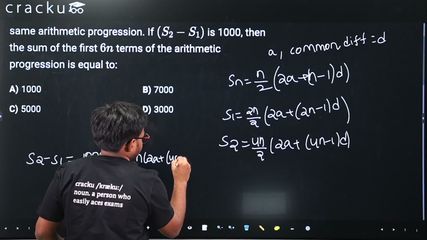
Let $$S_1$$ be the sum of first $$2n$$ terms of an arithmetic progression. Let $$S_2$$ be the sum of first $$4n$$ terms of the same arithmetic progression. If $$(S_2 - S_1)$$ is 1000, then the sum of the first $$6n$$ terms of the arithmetic progression is equal to:
Let the first term of the AP be $$a$$ and the common difference be $$d$$. The sum of the first $$k$$ terms of an AP is $$S_k = \frac{k}{2}[2a + (k-1)d]$$.
So $$S_1 = S_{2n} = \frac{2n}{2}[2a + (2n-1)d] = n[2a + (2n-1)d]$$ and $$S_2 = S_{4n} = \frac{4n}{2}[2a + (4n-1)d] = 2n[2a + (4n-1)d]$$.
Computing $$S_2 - S_1 = 2n[2a + (4n-1)d] - n[2a + (2n-1)d]$$. Expanding: $$= 4na + 2n(4n-1)d - 2na - n(2n-1)d = 2na + nd[2(4n-1) - (2n-1)] = 2na + nd(6n - 1) = n[2a + (6n-1)d] = 1000$$.
Now the sum of the first $$6n$$ terms is $$S_{6n} = \frac{6n}{2}[2a + (6n-1)d] = 3n[2a + (6n-1)d]$$. Notice that $$S_{6n} = 3 \times n[2a + (6n-1)d] = 3 \times 1000 = 3000$$.
The sum of the first $$6n$$ terms is $$3000$$, which is option (4).
Was this solution helpful?
Click on the Email ☝️ to Watch the Video Solution
Create a FREE account and get:
_1.webp)

Educational materials for JEE preparation

Ask our AI anything

AI can make mistakes. Please verify important information.
AI can make mistakes. Please verify important information.
