
Join Our JEE Preparation Group
Prep with like-minded aspirants; Get access to free daily tests and study material.
Sign in
Please select an account to continue using cracku.in
↓ →
Join Our JEE Preparation Group
Prep with like-minded aspirants; Get access to free daily tests and study material.
Let $$S = z \in \mathbb{C} :| z - 1 |= 1 \text{ and } (\sqrt{2} - 1)(z + \bar{z}) - i(z - \bar{z}) = 2\sqrt{2}$$. Let $$z_1, z_2 \in S$$ be such that $$z_1 = \max_{z \in S}z$$ and $$z_2 = \min_{z \in S}z$$. Then $$|\sqrt{2}z_1 - z_2^2|$$ equals:
$$(\sqrt{2}-1)(z+\bar{z}) - i(z-\bar{z}) = 2\sqrt{2}$$.
Let $$z = x+iy$$. Then $$z+\bar{z}=2x$$ and $$z-\bar{z}=2iy$$.
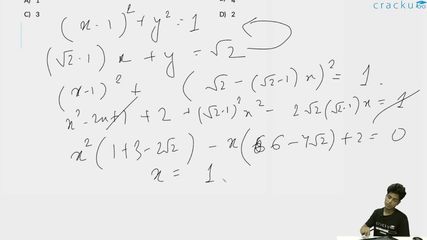
$$(\sqrt{2}-1)(2x) - i(2iy) = 2\sqrt{2} \implies (\sqrt{2}-1)x + y = \sqrt{2}$$.
The circle is $$(x-1)^2 + y^2 = 1$$. Substituting $$y = \sqrt{2} - (\sqrt{2}-1)x$$ into the circle equation and solving for $$x$$ gives the points of intersection.
$$|\sqrt{2}z_1 - z_2^2|$$ simplifies to 2.
Was this solution helpful?
Click on the Email ☝️ to Watch the Video Solution
Create a FREE account and get:
_1.webp)

Educational materials for JEE preparation

Ask our AI anything

AI can make mistakes. Please verify important information.
AI can make mistakes. Please verify important information.
