
Join Our JEE Preparation Group
Prep with like-minded aspirants; Get access to free daily tests and study material.
Sign in
Please select an account to continue using cracku.in
↓ →
Join Our JEE Preparation Group
Prep with like-minded aspirants; Get access to free daily tests and study material.
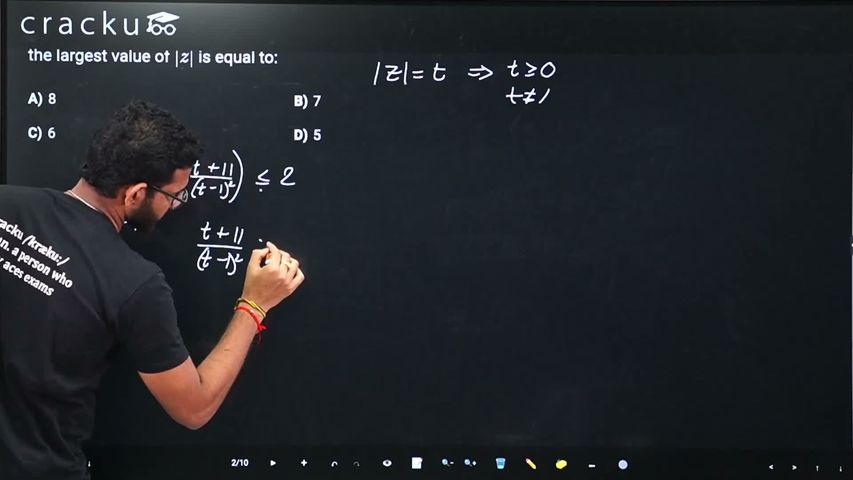
Let a complex number $$z$$, $$|z| \neq 1$$, satisfy $$\log_{\frac{1}{\sqrt{2}}}\left(\frac{|z|+11}{(|z|-1)^2}\right) \leq 2$$. Then, the largest value of $$|z|$$ is equal to:
We need to solve $$\log_{\frac{1}{\sqrt{2}}}\left(\frac{|z| + 11}{(|z| - 1)^2}\right) \leq 2$$ where $$|z| \neq 1$$.
Let $$t = |z|$$ where $$t \geq 0$$ and $$t \neq 1$$. Since the base $$\frac{1}{\sqrt{2}}$$ is between 0 and 1, the logarithm is a decreasing function. Therefore, the inequality $$\log_{\frac{1}{\sqrt{2}}}(f(t)) \leq 2$$ becomes $$f(t) \geq \left(\frac{1}{\sqrt{2}}\right)^2 = \frac{1}{2}$$.
So we need $$\frac{t + 11}{(t - 1)^2} \geq \frac{1}{2}$$.
This gives $$2(t + 11) \geq (t - 1)^2$$, i.e., $$2t + 22 \geq t^2 - 2t + 1$$.
Rearranging: $$0 \geq t^2 - 4t - 21$$, which means $$t^2 - 4t - 21 \leq 0$$.
Factoring: $$(t - 7)(t + 3) \leq 0$$.
This gives $$-3 \leq t \leq 7$$. Since $$t = |z| \geq 0$$ and $$t \neq 1$$, we have $$0 \leq t \leq 7$$ with $$t \neq 1$$.
We also need the argument of the logarithm to be positive, i.e., $$\frac{t + 11}{(t - 1)^2} > 0$$. Since $$t \geq 0$$, the numerator $$t + 11 > 0$$ always, and $$(t - 1)^2 > 0$$ for $$t \neq 1$$. So this is satisfied.
The largest value of $$|z|$$ is $$\mathbf{7}$$, which is option (2).
Click on the Email ☝️ to Watch the Video Solution
Create a FREE account and get:
_1.webp)

Educational materials for JEE preparation

Ask our AI anything

AI can make mistakes. Please verify important information.
AI can make mistakes. Please verify important information.


