
Join Our JEE Preparation Group
Prep with like-minded aspirants; Get access to free daily tests and study material.
Sign in
Please select an account to continue using cracku.in
↓ →
Join Our JEE Preparation Group
Prep with like-minded aspirants; Get access to free daily tests and study material.
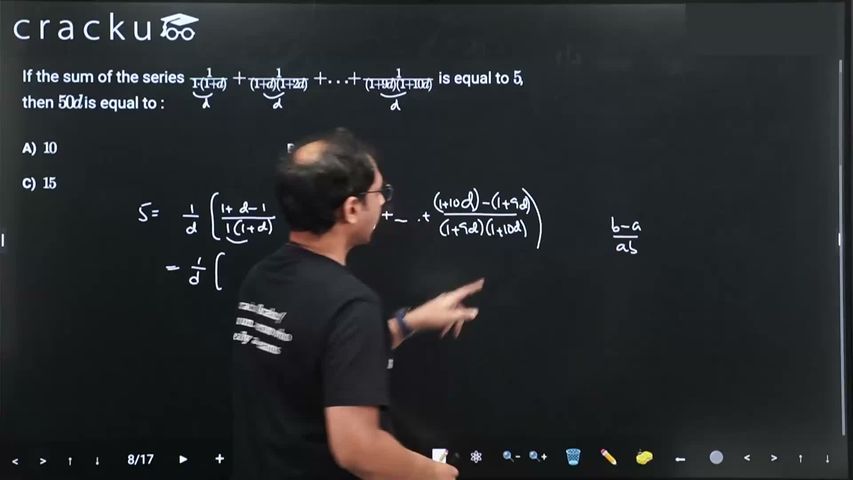
If the sum of the series $$\frac{1}{1 \cdot (1+d)} + \frac{1}{(1+d)(1+2d)} + \ldots + \frac{1}{(1+9d)(1+10d)}$$ is equal to $$5$$, then $$50d$$ is equal to :
To solve this series, notice that the terms in the denominators form an Arithmetic Progression with a common difference of $$d$$.
To evaluate this, multiply and divide the entire left-hand side by the common difference $$d$$ to set up a telescoping series:
$$\frac{1}{d} \left[ \frac{d}{1(1+d)} + \frac{d}{(1+d)(1+2d)} + \dots + \frac{d}{(1+9d)(1+10d)} \right] = 5$$
Now, express the numerator $$d$$ in each term as the difference between the two factors in its denominator:
$$\frac{1}{d} \left[ \frac{(1+d) - 1}{1(1+d)} + \frac{(1+2d) - (1+d)}{(1+d)(1+2d)} + \dots + \frac{(1+10d) - (1+9d)}{(1+9d)(1+10d)} \right] = 5$$
Split each fraction into two separate terms. You will see a clear pattern where consecutive terms cancel out:
$$\frac{1}{d} \left[ \left(\frac{1}{1} - \frac{1}{1+d}\right) + \left(\frac{1}{1+d} - \frac{1}{1+2d}\right) + \dots + \left(\frac{1}{1+9d} - \frac{1}{1+10d}\right) \right] = 5$$
After all the intermediate terms cancel each other, you are left with just the first part of the first term and the second part of the last term:
$$\frac{1}{d} \left[ 1 - \frac{1}{1+10d} \right] = 5$$
Take the LCM to simplify the expression inside the bracket:
$$\frac{1}{d} \left[ \frac{(1 + 10d) - 1}{1+10d} \right] = 5$$
$$\frac{1}{d} \left[ \frac{10d}{1+10d} \right] = 5$$
The $$d$$ in the numerator and denominator perfectly cancels out:
$$\frac{10}{1+10d} = 5$$
Now, just solve for $$50d$$:
$$10 = 5(1+10d)$$
$$10 = 5 + 50d$$
$$50d = 5$$
Was this solution helpful?
Click on the Email ☝️ to Watch the Video Solution
Create a FREE account and get:
_1.webp)

Educational materials for JEE preparation

Ask our AI anything

AI can make mistakes. Please verify important information.
AI can make mistakes. Please verify important information.
