
Join Our JEE Preparation Group
Prep with like-minded aspirants; Get access to free daily tests and study material.
Sign in
Please select an account to continue using cracku.in
↓ →
Join Our JEE Preparation Group
Prep with like-minded aspirants; Get access to free daily tests and study material.
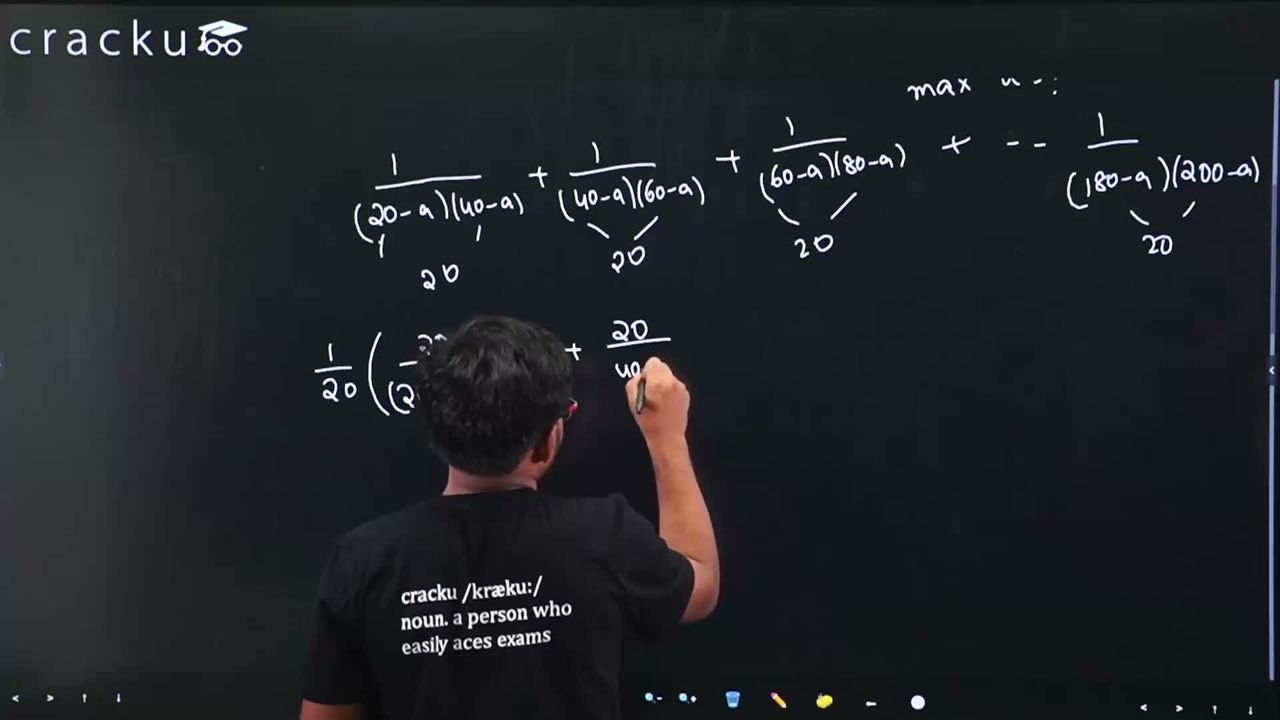
If $$\frac{1}{(20-a)(40-a)} + \frac{1}{(40-a)(60-a)} + \ldots + \frac{1}{(180-a)(200-a)} = \frac{1}{256}$$, then the maximum value of $$a$$ is
We are given the sum $$\frac{1}{(20-a)(40-a)} + \frac{1}{(40-a)(60-a)} + \cdots + \frac{1}{(180-a)(200-a)} = \frac{1}{256}$$ and we need to find the maximum value of $$a$$.
We observe that the terms in the denominators form an arithmetic progression with common difference 20. Let us define $$u_k = 20k - a$$ for $$k = 1, 2, \ldots, 10$$, so that $$u_{k+1} - u_k = 20$$ for all $$k$$. The given sum can be written as $$\displaystyle\sum_{k=1}^{9} \frac{1}{u_k \cdot u_{k+1}}$$.
Now, using partial fractions with the identity $$\frac{1}{u_k \cdot u_{k+1}} = \frac{1}{u_{k+1} - u_k}\left(\frac{1}{u_k} - \frac{1}{u_{k+1}}\right) = \frac{1}{20}\left(\frac{1}{u_k} - \frac{1}{u_{k+1}}\right)$$, the sum telescopes to give $$\frac{1}{20}\left(\frac{1}{u_1} - \frac{1}{u_{10}}\right) = \frac{1}{20}\left(\frac{1}{20 - a} - \frac{1}{200 - a}\right)$$.
Simplifying the expression inside the parentheses: $$\frac{1}{20 - a} - \frac{1}{200 - a} = \frac{(200 - a) - (20 - a)}{(20 - a)(200 - a)} = \frac{180}{(20 - a)(200 - a)}$$.
Hence the sum equals $$\frac{180}{20 \cdot (20 - a)(200 - a)} = \frac{9}{(20 - a)(200 - a)}$$.
Setting this equal to $$\frac{1}{256}$$, we get $$(20 - a)(200 - a) = 9 \times 256 = 2304$$.
Expanding: $$4000 - 220a + a^2 = 2304$$, which simplifies to $$a^2 - 220a + 1696 = 0$$.
Using the quadratic formula: $$a = \frac{220 \pm \sqrt{220^2 - 4 \times 1696}}{2} = \frac{220 \pm \sqrt{48400 - 6784}}{2} = \frac{220 \pm \sqrt{41616}}{2}$$.
We compute $$\sqrt{41616}$$: since $$204^2 = 41616$$, we have $$a = \frac{220 \pm 204}{2}$$.
This gives $$a = \frac{220 + 204}{2} = 212$$ or $$a = \frac{220 - 204}{2} = 8$$.
The maximum value of $$a$$ is $$212$$.
Hence, the correct answer is Option C.
Was this solution helpful?
Click on the Email ☝️ to Watch the Video Solution
Create a FREE account and get:
_1.webp)

Educational materials for JEE preparation

Ask our AI anything

AI can make mistakes. Please verify important information.
AI can make mistakes. Please verify important information.
