
Join Our JEE Preparation Group
Prep with like-minded aspirants; Get access to free daily tests and study material.
Sign in
Please select an account to continue using cracku.in
↓ →
Join Our JEE Preparation Group
Prep with like-minded aspirants; Get access to free daily tests and study material.
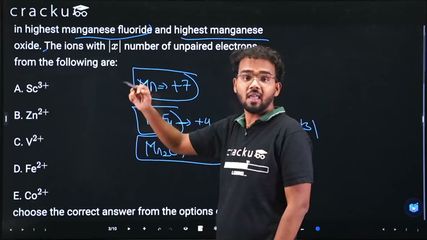
Consider $$|x|$$ is the difference in oxidation states of Mn in highest manganese fluoride and highest manganese oxide. The ions with $$|x|$$ number of unpaired electrons from the following are:
A. Sc$$^{3+}$$
B. Zn$$^{2+}$$
C. V$$^{2+}$$
D. Fe$$^{2+}$$
E. Co$$^{2+}$$
choose the correct answer from the options given below :
Manganese lies in group 7 of the periodic table, so its maximum oxidation number is $$+7$$ when it can lose all seven valence electrons.
Highest fluoride of Mn
Fluorine is the most electronegative element, yet only $$\mathrm{MnF_4}$$ is well-established. In it
$$\mathrm{Mn}^{+4} + 4\,\mathrm{F}^- \rightarrow \mathrm{MnF_4}$$
Therefore the highest confirmed oxidation state of Mn in a fluoride is $$+4$$.
Highest oxide of Mn
In $$\mathrm{Mn_2O_7}$$ the oxidation state is
$$2(\text{Mn}) + 7(-2) = 0 \;\Rightarrow\; \text{Mn} = +7$$
Hence the required difference is
$$|x| = |(+7) - (+4)| = 3$$
We now need the given metal ions that possess exactly $$3$$ unpaired electrons.
Electronic configurations and unpaired electrons
(A) Sc$$^{3+}$$ : Sc (21) is $$[\mathrm{Ar}]\,3d^1 4s^2$$; removing three electrons gives $$[\mathrm{Ar}]$$, i.e. $$3d^0$$ ⟹ 0 unpaired.
(B) Zn$$^{2+}$$ : Zn (30) is $$[\mathrm{Ar}]\,3d^{10} 4s^2$$; Zn$$^{2+}$$ is $$[\mathrm{Ar}]\,3d^{10}$$ ⟹ 0 unpaired.
(C) V$$^{2+}$$ : V (23) is $$[\mathrm{Ar}]\,3d^{3}4s^{2}$$; V$$^{2+}$$ loses the two 4s electrons → $$[\mathrm{Ar}]\,3d^{3}$$.
A $$d^{3}$$ set has one electron in each of three different d-orbitals ⟹ 3 unpaired.
(D) Fe$$^{2+}$$ : Fe (26) is $$[\mathrm{Ar}]\,3d^{6}4s^{2}$$; Fe$$^{2+}$$ is $$[\mathrm{Ar}]\,3d^{6}$$.
For a free (high-spin) $$d^{6}$$ ion the distribution is ↑↓ ↑ ↑ ↑ ↑ giving 4 unpaired.
(E) Co$$^{2+}$$ : Co (27) is $$[\mathrm{Ar}]\,3d^{7}4s^{2}$$; Co$$^{2+}$$ is $$[\mathrm{Ar}]\,3d^{7}$$.
A high-spin $$d^{7}$$ arrangement (↑↓ ↑↓ ↑ ↑ ↑) contains 3 unpaired electrons.
The ions with exactly three unpaired electrons are V$$^{2+}$$ and Co$$^{2+}$$, i.e. Option C.
Final Answer: Option C which is: C, E Only
Was this solution helpful?
Click on the Email ☝️ to Watch the Video Solution
Create a FREE account and get:
_1.webp)

Educational materials for JEE preparation

Ask our AI anything

AI can make mistakes. Please verify important information.
AI can make mistakes. Please verify important information.


