
Join Our JEE Preparation Group
Prep with like-minded aspirants; Get access to free daily tests and study material.
Sign in
Please select an account to continue using cracku.in
↓ →
Join Our JEE Preparation Group
Prep with like-minded aspirants; Get access to free daily tests and study material.
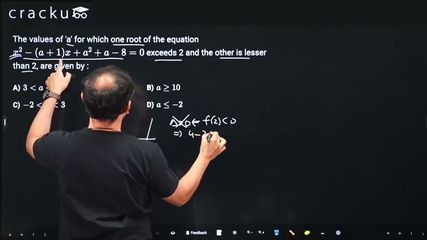
The values of 'a' for which one root of the equation $$x^2 - (a+1)x + a^2 + a - 8 = 0$$ exceeds 2 and the other is lesser than 2, are given by :
We are given the quadratic equation $$ x^2 - (a+1)x + a^2 + a - 8 = 0 $$. We need to find the values of $$ a $$ such that one root is greater than 2 and the other root is less than 2. Since the coefficient of $$ x^2 $$ is positive, the parabola opens upwards. For one root to be greater than 2 and the other less than 2, the point $$ x = 2 $$ must lie between the roots. This means the function value at $$ x = 2 $$ must be negative.
Define the quadratic function as $$ f(x) = x^2 - (a+1)x + a^2 + a - 8 $$. Evaluate $$ f(2) $$:
$$ f(2) = (2)^2 - (a+1)(2) + a^2 + a - 8 $$
$$ = 4 - 2(a+1) + a^2 + a - 8 $$
$$ = 4 - 2a - 2 + a^2 + a - 8 $$
$$ = a^2 - a - 6 $$
Set $$ f(2) < 0 $$:
$$ a^2 - a - 6 < 0 $$
Factor the quadratic expression:
$$ a^2 - a - 6 = (a - 3)(a + 2) $$
So,
$$ (a - 3)(a + 2) < 0 $$
The roots are $$ a = 3 $$ and $$ a = -2 $$. These divide the real line into intervals: $$ (-\infty, -2) $$, $$ (-2, 3) $$, and $$ (3, \infty) $$. Test the sign in each interval:
The expression is negative only when $$ -2 < a < 3 $$. However, we must ensure the quadratic has two distinct real roots, so the discriminant must be positive.
The discriminant $$ D $$ is:
$$ D = [-(a+1)]^2 - 4(1)(a^2 + a - 8) $$
$$ = (a+1)^2 - 4(a^2 + a - 8) $$
$$ = a^2 + 2a + 1 - 4a^2 - 4a + 32 $$
$$ = -3a^2 - 2a + 33 $$
Set $$ D > 0 $$:
$$ -3a^2 - 2a + 33 > 0 $$
Multiply both sides by -1 (reverse the inequality):
$$ 3a^2 + 2a - 33 < 0 $$
Solve $$ 3a^2 + 2a - 33 = 0 $$ using the quadratic formula:
$$ a = \frac{ -2 \pm \sqrt{ (2)^2 - 4(3)(-33) } }{2(3)} $$
$$ = \frac{ -2 \pm \sqrt{4 + 396} }{6} $$
$$ = \frac{ -2 \pm \sqrt{400} }{6} $$
$$ = \frac{ -2 \pm 20 }{6} $$
So, the roots are:
$$ a = \frac{18}{6} = 3 \quad \text{and} \quad a = \frac{-22}{6} = -\frac{11}{3} $$
Factor the quadratic:
$$ 3a^2 + 2a - 33 = (a - 3)(3a + 11) $$
Thus,
$$ (a - 3)(3a + 11) < 0 $$
The roots are $$ a = 3 $$ and $$ a = -\frac{11}{3} \approx -3.6667 $$. Since the parabola opens upwards, the expression is negative between the roots:
$$ -\frac{11}{3} < a < 3 $$
Now, combine both conditions:
The intersection is $$ \max(-2, -\frac{11}{3}) < a < \min(3, 3) $$, which simplifies to $$ -2 < a < 3 $$ because $$ -2 > -\frac{11}{3} $$.
Check the endpoints:
Thus, $$ a = -2 $$ and $$ a = 3 $$ are excluded, and the strict inequality $$ -2 < a < 3 $$ holds.
Verify with a test point in $$ (-2, 3) $$, say $$ a = 0 $$:
$$ f(x) = x^2 - x - 8 = 0 $$
Roots: $$ \frac{1 \pm \sqrt{1 + 32}}{2} = \frac{1 \pm \sqrt{33}}{2} \approx \frac{1 \pm 5.744}{2} $$, so approximately $$ 3.372 $$ and $$ -2.372 $$. One root exceeds 2, the other is less than 2.
Comparing with the options:
A. $$ 3 < a < 10 $$
B. $$ a \geq 10 $$
C. $$ -2 < a < 3 $$
D. $$ a \leq -2 $$
The condition $$ -2 < a < 3 $$ matches option C.
Hence, the correct answer is Option C.
Was this solution helpful?
Click on the Email ☝️ to Watch the Video Solution
Create a FREE account and get:
_1.webp)

Educational materials for JEE preparation

Ask our AI anything

AI can make mistakes. Please verify important information.
AI can make mistakes. Please verify important information.


