
Join Our JEE Preparation Group
Prep with like-minded aspirants; Get access to free daily tests and study material.
Sign in
Please select an account to continue using cracku.in
↓ →
Join Our JEE Preparation Group
Prep with like-minded aspirants; Get access to free daily tests and study material.
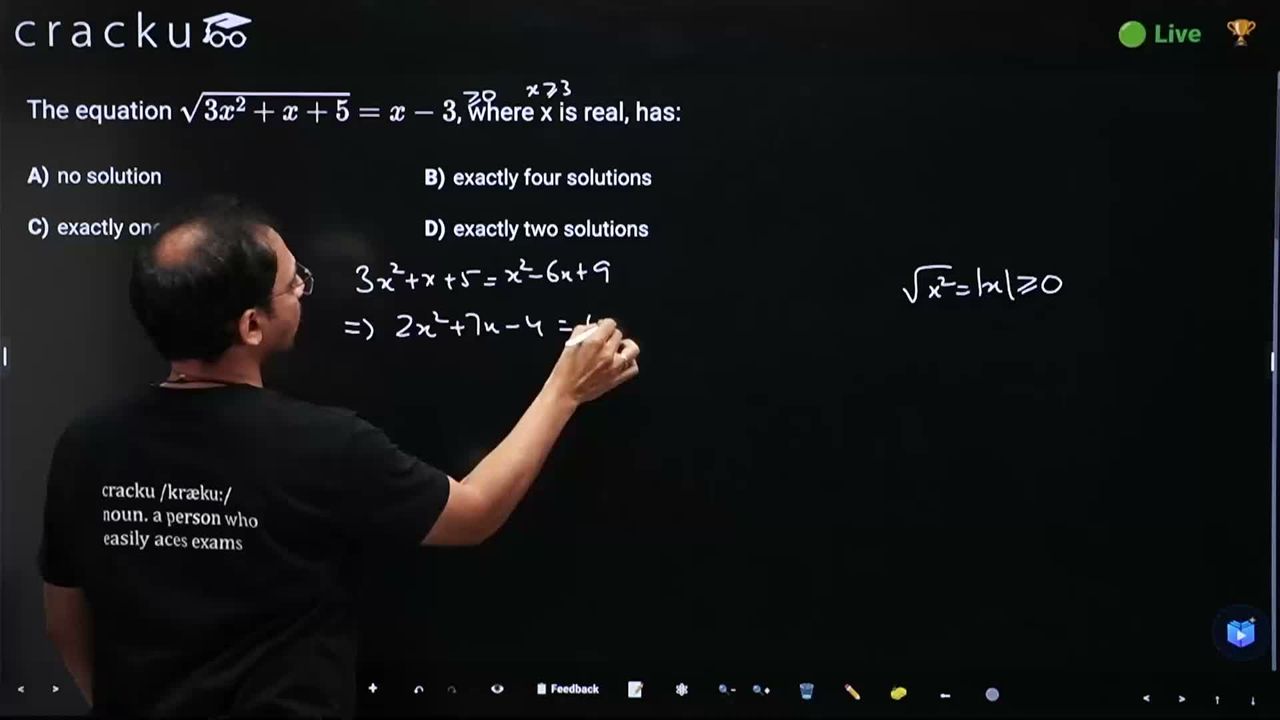
We start with the equation: $$\sqrt{3x^2 + x + 5} = x - 3$$
Since the square root function always gives a non-negative result, the right-hand side must be greater than or equal to zero. Therefore, we have the condition: $$x - 3 \geq 0 \quad \Rightarrow \quad x \geq 3$$
Any solution must satisfy $$x \geq 3$$. To solve the equation, we square both sides to eliminate the square root. However, squaring can introduce extraneous solutions, so we must check any solutions against the original equation.
Squaring both sides: $$\left( \sqrt{3x^2 + x + 5} \right)^2 = (x - 3)^2$$
This simplifies to: $$3x^2 + x + 5 = (x - 3)^2$$
Expanding the right-hand side: $$(x - 3)^2 = x^2 - 6x + 9$$
So the equation becomes: $$3x^2 + x + 5 = x^2 - 6x + 9$$
Bring all terms to the left-hand side: $$3x^2 + x + 5 - x^2 + 6x - 9 = 0$$
Combine like terms: $$(3x^2 - x^2) + (x + 6x) + (5 - 9) = 0 \quad \Rightarrow \quad 2x^2 + 7x - 4 = 0$$
We now have a quadratic equation: $$2x^2 + 7x - 4 = 0$$. Solve using the quadratic formula: $$x = \frac{-b \pm \sqrt{b^2 - 4ac}}{2a}$$ where $$a = 2$$, $$b = 7$$, and $$c = -4$$.
First, compute the discriminant: $$D = b^2 - 4ac = (7)^2 - 4(2)(-4) = 49 + 32 = 81$$
Since $$D = 81 > 0$$, there are two real roots. Now compute the roots: $$x = \frac{-7 \pm \sqrt{81}}{4} = \frac{-7 \pm 9}{4}$$
So the roots are: $$x = \frac{-7 + 9}{4} = \frac{2}{4} = \frac{1}{2} \quad \text{and} \quad x = \frac{-7 - 9}{4} = \frac{-16}{4} = -4$$
We have two solutions: $$x = \frac{1}{2}$$ and $$x = -4$$. However, recall the condition $$x \geq 3$$. Neither solution satisfies this: $$\frac{1}{2} = 0.5 < 3$$ and $$-4 < 3$$.
Now, verify by substituting back into the original equation. For $$x = \frac{1}{2}$$:
Left-hand side: $$\sqrt{3\left(\frac{1}{2}\right)^2 + \frac{1}{2} + 5} = \sqrt{3 \cdot \frac{1}{4} + 0.5 + 5} = \sqrt{0.75 + 0.5 + 5} = \sqrt{6.25} = 2.5$$
Right-hand side: $$\frac{1}{2} - 3 = -2.5$$
$$2.5 \neq -2.5$$, and the square root cannot equal a negative number.
For $$x = -4$$:
Left-hand side: $$\sqrt{3(-4)^2 + (-4) + 5} = \sqrt{3 \cdot 16 - 4 + 5} = \sqrt{48 - 4 + 5} = \sqrt{49} = 7$$
Right-hand side: $$-4 - 3 = -7$$
$$7 \neq -7$$, again invalid.
Since both solutions are invalid and there are no other solutions, the equation has no solution.
Options:
A. no solution
B. exactly four solutions
C. exactly one solution
D. exactly two solutions
Hence, the correct answer is Option A.
Was this solution helpful?
Click on the Email ☝️ to Watch the Video Solution
Create a FREE account and get:
_1.webp)

Educational materials for JEE preparation

Ask our AI anything

AI can make mistakes. Please verify important information.
AI can make mistakes. Please verify important information.
