
Join Our JEE Preparation Group
Prep with like-minded aspirants; Get access to free daily tests and study material.
Sign in
Please select an account to continue using cracku.in
↓ →
Join Our JEE Preparation Group
Prep with like-minded aspirants; Get access to free daily tests and study material.
The equation $$\arg\left(\frac{z-1}{z+1}\right) = \frac{\pi}{4}$$ represents a circle with:
Let us denote the required complex number by $$z$$ and write it in the usual Cartesian form
$$z = x + iy, \qquad \text{where } x, y \in \mathbb R.$$
The given condition is
$$\arg\!\left(\dfrac{z-1}{\,z+1\,}\right)=\dfrac{\pi}{4}.$$
For any complex number $$W = A + iB,$$ we recall the basic fact
$$\arg(W)=\theta \;\Longrightarrow\; \dfrac{B}{A}=\tan\theta.$$
Since $$\tan\!\left(\dfrac{\pi}{4}\right)=1,$$ the above gives the simple relation
$$B = A.$$
Thus, for the complex quotient
$$W=\dfrac{z-1}{z+1},$$
we merely have to equate its imaginary and real parts. We therefore proceed to calculate these two parts explicitly.
First write the numerator and the denominator in terms of $$x$$ and $$y$$:
$$z-1 = (x-1)+iy, \qquad z+1 = (x+1)+iy.$$
To find $$W$$ conveniently, multiply numerator and denominator by the complex conjugate of the denominator:
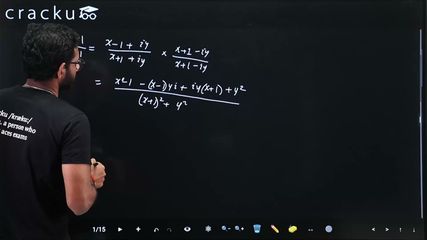
$$\dfrac{z-1}{z+1}= \dfrac{(x-1)+iy}{(x+1)+iy}\; \times\; \dfrac{(x+1)-iy}{(x+1)-iy}.$$
The denominator thus becomes the real number
$$\bigl(x+1\bigr)^2 + y^2.$$
Let us expand the numerator carefully, multiplying the two binomials term by term:
$$ \bigl[(x-1)+iy\bigr]\bigl[(x+1)-iy\bigr] = (x-1)(x+1) + (x-1)(-iy) + iy(x+1) + iy(-iy). $$
Compute each piece:
$$(x-1)(x+1) = x^2-1,$$
$$(x-1)(-iy) = -i y x + i y,$$
$$iy(x+1) = i y x + i y,$$
$$iy(-iy) = -i^2 y^2 = +y^2.$$
Adding the real parts and the imaginary parts separately we obtain
$$ x^2 - 1 + y^2 \;+\; 2 i y. $$
Hence
$$W=\dfrac{(x^2+y^2-1) + 2iy}{(x+1)^2 + y^2}.$$
From this expression we read off
$$\operatorname{Re}(W)=\dfrac{x^2 + y^2 -1}{(x+1)^2 + y^2}, \qquad \operatorname{Im}(W)=\dfrac{2y}{(x+1)^2 + y^2}.$$
Because the denominator is strictly positive, the equality of the imaginary and real parts entails
$$2y = x^2 + y^2 -1.$$
Let us bring every term to one side:
$$x^2 + y^2 - 2y - 1 = 0.$$
To recognise a circle we complete the square in the $$y$$-variable. Observe that
$$y^2 - 2y = (y-1)^2 - 1.$$
Substituting this into the equation gives
$$x^2 + \bigl[(y-1)^2 - 1\bigr] - 1 = 0.$$
Simplifying further,
$$x^2 + (y-1)^2 - 2 = 0,$$
or equivalently,
$$x^2 + (y-1)^2 = 2.$$
This is the standard form of a circle. Comparing with
$$ (x-h)^2 + (y-k)^2 = R^2,$$
we immediately read
Centre $$= (h,k) = (0,1), \qquad \text{Radius} \; R = \sqrt{2}.$$
Consequently the curve represented by the given argument condition is the circle centred at $$(0,1)$$ with radius $$\sqrt{2}$$.
Hence, the correct answer is Option D.
Was this solution helpful?
Click on the Email ☝️ to Watch the Video Solution
Create a FREE account and get:
_1.webp)

Educational materials for JEE preparation

Ask our AI anything

AI can make mistakes. Please verify important information.
AI can make mistakes. Please verify important information.
