
Join Our JEE Preparation Group
Prep with like-minded aspirants; Get access to free daily tests and study material.
Sign in
Please select an account to continue using cracku.in
↓ →
Join Our JEE Preparation Group
Prep with like-minded aspirants; Get access to free daily tests and study material.
The correct order of $$[FeF_6]^{3-}$$, $$[CoF_6]^{3-}$$, $$[Ni(CO)_4]$$ and $$[Ni(CN)_4]^{2-}$$ complex species based on the number of unpaired electrons present is :
First find the oxidation state and the ground-state $$3d$$ electron configuration of the central metal ion in each complex.
$$[FeF_6]^{3-} :$$
Fluoride is $$-1$$, six ligands give $$-6$$.
Let oxidation state of Fe be $$x$$.
$$x-6 = -3 \Rightarrow x = +3$$.
Fe atom: $$[Ar]\,3d^6 4s^2$$ ⇒ $$Fe^{3+}: [Ar]\,3d^5$$ (configuration $$d^5$$).
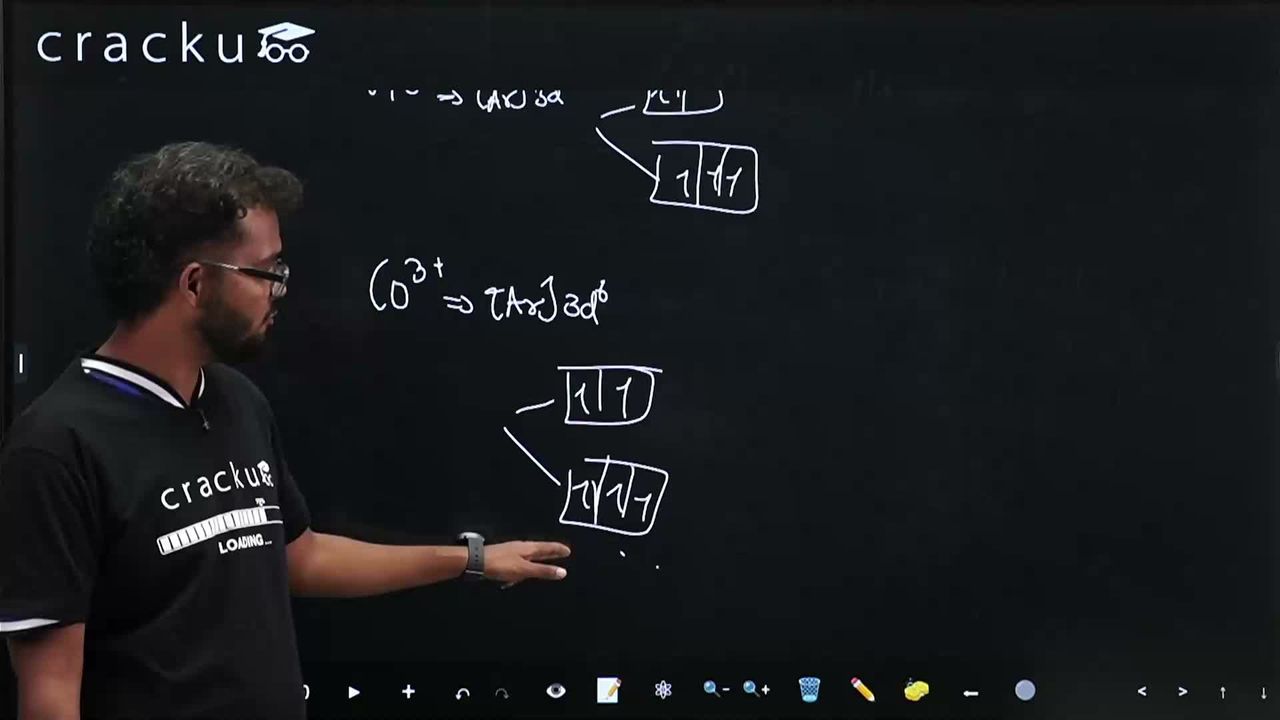
$$[CoF_6]^{3-} :$$
Similarly, $$x-6 = -3 \Rightarrow x = +3$$.
Co atom: $$[Ar]\,3d^7 4s^2$$ ⇒ $$Co^{3+}: [Ar]\,3d^6$$ (configuration $$d^6$$).
$$[Ni(CO)_4] :$$
Carbonyl is neutral. Total charge $$0$$, so Ni is in $$0$$ oxidation state.
Ni atom: $$[Ar]\,3d^8 4s^2$$ ⇒ $$Ni^{0}: [Ar]\,3d^{10} 4s^{0}$$ (configuration $$d^{10}$$).
$$[Ni(CN)_4]^{2-} :$$
Cyanide is $$-1$$, four ligands give $$-4$$.
Let oxidation state of Ni be $$x$$.
$$x-4 = -2 \Rightarrow x = +2$$.
Ni atom: $$[Ar]\,3d^8 4s^2$$ ⇒ $$Ni^{2+}: [Ar]\,3d^8$$ (configuration $$d^8$$).
Next decide whether the complex is high-spin or low-spin and its geometry, using ligand field strength:
• $$F^-$$ is a weak-field ligand (spectrochemical series). Octahedral complexes with $$F^-$$ are high-spin.
• $$CO$$ and $$CN^-$$ are strong-field ligands. $$CO$$ gives a tetrahedral, completely filled $$sp^3$$ complex with Ni(0). $$CN^-$$ gives a square-planar, low-spin $$dsp^2$$ complex with Ni(II).
Now place the electrons:
Case 1: $$[FeF_6]^{3-}$$ (octahedral, high-spin, $$d^5$$)
Electrons fill all five $$d$$ orbitals singly ⇒ number of unpaired electrons $$=5$$.
Case 2: $$[CoF_6]^{3-}$$ (octahedral, high-spin, $$d^6$$)
Arrangement: $$t_{2g}^4 e_g^2$$ ⇒ unpaired electrons $$=4$$.
Case 3: $$[Ni(CO)_4]$$ (tetrahedral, $$d^{10}$$, $$sp^3$$)
All ten $$d$$ electrons are paired ⇒ unpaired electrons $$=0$$.
Case 4: $$[Ni(CN)_4]^{2-}$$ (square-planar, low-spin, $$d^8$$, $$dsp^2$$)
Electron distribution: $$d_{x^2-y^2}^0, d_{z^2}^2, d_{xy}^2, d_{xz}^2, d_{yz}^2$$ ⇒ unpaired electrons $$=0$$.
Collecting the results:
$$[FeF_6]^{3-} : 5 \; \gt$$
$$[CoF_6]^{3-} : 4 \; \gt$$
$$[Ni(CN)_4]^{2-} : 0$$ and $$[Ni(CO)_4] : 0$$ (equal).
Therefore the correct descending order of unpaired electrons is
$$[FeF_6]^{3-} \gt [CoF_6]^{3-} \gt [Ni(CN)_4]^{2-} = [Ni(CO)_4]$$.
This corresponds to Option D.
Click on the Email ☝️ to Watch the Video Solution
Create a FREE account and get:
_1.webp)

Educational materials for JEE preparation

Ask our AI anything

AI can make mistakes. Please verify important information.
AI can make mistakes. Please verify important information.


