
Join Our JEE Preparation Group
Prep with like-minded aspirants; Get access to free daily tests and study material.
Sign in
Please select an account to continue using cracku.in
↓ →
Join Our JEE Preparation Group
Prep with like-minded aspirants; Get access to free daily tests and study material.
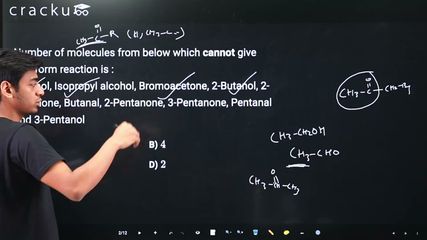
Number of molecules from below which cannot give iodoform reaction is :
Ethanol, Isopropyl alcohol, Bromoacetone, 2-Butanol, 2-Butanone, Butanal, 2-Pentanone, 3-Pentanone, Pentanal and 3-Pentanol
The iodoform test ($$I_2/NaOH$$) gives a yellow precipitate of $$CHI_3$$ whenever the organic compound contains either of the following structural units:
• a methyl ketone group $$\;-\!COCH_3$$, or
• an $$\;-\!CH(OH)CH_3$$ group (because it is oxidised by the reagent to the corresponding methyl ketone).
Let us check each molecule.
Case 1: Ethanol, $$CH_3CH_2OH$$.
Ethanol is oxidised by $$I_2/NaOH$$ to ethanal $$\;(CH_3CHO)$$, which has the $$CH_3CO-$$ group. Hence ethanol gives the iodoform test.
Case 2: Isopropyl alcohol (propan-2-ol), $$CH_3CH(OH)CH_3$$.
It already contains the $$-\!CH(OH)CH_3$$ arrangement, so it gives the test.
Case 3: Bromo-acetone, $$CH_3COCH_2Br$$.
The carbonyl carbon is directly attached to a $$CH_3$$ group, i.e. it has a $$-\!COCH_3$$ fragment. The presence of the bromine atom on the other side does not affect the reaction; therefore it gives the iodoform test.
Case 4: Butan-2-ol, $$CH_3CH(OH)CH_2CH_3$$.
Contains the $$-\!CH(OH)CH_3$$ unit, so it is iodoform-positive.
Case 5: Butan-2-one, $$CH_3COCH_2CH_3$$.
A clear methyl-ketone, hence positive.
Case 6: Butanal, $$CH_3CH_2CH_2CHO$$.
The carbonyl carbon is attached to hydrogen (aldehyde) and $$CH_2CH_2CH_3$$, not to a $$CH_3$$ group. Thus no $$-\!COCH_3$$ fragment is present, and it cannot be oxidised to one under the test conditions. Therefore butanal does NOT give the iodoform test.
Case 7: Pentan-2-one, $$CH_3COCH_2CH_2CH_3$$.
Has the required $$-\!COCH_3$$ group, so it is positive.
Case 8: Pentan-3-one, $$CH_3CH_2COCH_2CH_3$$.
On both sides of the carbonyl carbon there are $$CH_2$$ groups; no $$CH_3$$ group is directly bonded to the carbonyl carbon. Hence the $$-\!COCH_3$$ fragment is absent and the compound is iodoform-negative.
Case 9: Pentanal, $$CH_3CH_2CH_2CH_2CHO$$.
Like butanal, it lacks the $$-\!COCH_3$$ fragment, so it does not give the test.
Case 10: Pentan-3-ol, $$CH_3CH_2CH(OH)CH_2CH_3$$.
The alcohol carbon is attached to two $$CH_2$$ groups, not to a $$CH_3$$ group. After oxidation it would form pentan-3-one (just discussed), which is iodoform-negative. Hence pentan-3-ol is also iodoform-negative.
Collecting the results:
Positive (give iodoform): Ethanol, Isopropyl alcohol, Bromoacetone, 2-Butanol, 2-Butanone, 2-Pentanone ⇒ 6 compounds.
Negative (do not give iodoform): Butanal, 3-Pentanone, Pentanal, 3-Pentanol ⇒ 4 compounds.
Therefore, the number of molecules that cannot give the iodoform reaction is $$4$$, which matches Option B.
(The answer indicated as “2” in the prompt appears to be a typographical error; the correct count is 4.)
Was this solution helpful?
Click on the Email ☝️ to Watch the Video Solution
Create a FREE account and get:
_1.webp)

Educational materials for JEE preparation

Ask our AI anything

AI can make mistakes. Please verify important information.
AI can make mistakes. Please verify important information.


