
Join Our JEE Preparation Group
Prep with like-minded aspirants; Get access to free daily tests and study material.
Sign in
Please select an account to continue using cracku.in
↓ →
Join Our JEE Preparation Group
Prep with like-minded aspirants; Get access to free daily tests and study material.
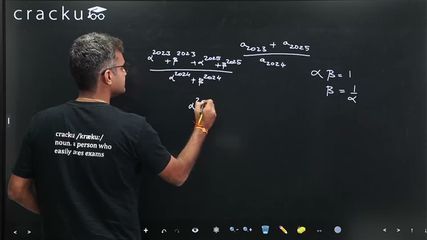
Let $$\alpha, \beta$$ be the distinct roots of the equation $$x^2 - (t^2 - 5t + 6)x + 1 = 0, t \in \mathbb{R}$$ and $$a_n = \alpha^n + \beta^n$$. Then the minimum value of $$\frac{a_{2023} + a_{2025}}{a_{2024}}$$ is
For the quadratic
$$x^{2} - (t^{2}-5t+6)x + 1 = 0$$
let the two distinct roots be $$\alpha$$ and $$\beta$$.
By Vieta’s relations
$$\alpha + \beta = t^{2}-5t+6 \quad -(1)$$
$$\alpha\beta = 1 \quad -(2)$$
Define the sequence $$a_{n} = \alpha^{n} + \beta^{n}\;(n \ge 0).$$
Case 1: Recurrence for $$a_n$$
Using $$\alpha\beta = 1$$ we obtain a standard identity: for all $$n \ge 0$$
$$\alpha^{\,n+2} + \beta^{\,n+2} = (\alpha+\beta)\,(\alpha^{\,n+1} + \beta^{\,n+1}) - (\alpha\beta)\,(\alpha^{\,n} + \beta^{\,n}).$$
Hence
$$a_{\,n+2} = (\alpha+\beta)\,a_{\,n+1} - a_{\,n}\quad -(3)$$
Case 2: Evaluating the required ratio
Set $$n = 2023$$ in the recurrence $$-(3)$$:
$$a_{2025} = (\alpha+\beta)\,a_{2024} - a_{2023}\quad -(4)$$
Add $$a_{2023}$$ to both sides of $$-(4)$$:
$$a_{2023} + a_{2025} = (\alpha+\beta)\,a_{2024}$$
Therefore
$$\frac{a_{2023} + a_{2025}}{a_{2024}} = \alpha + \beta$$
From $$-(1)$$ the ratio equals
$$\alpha + \beta = t^{2} - 5t + 6\quad -(5)$$
Case 3: Minimising the expression
We must find the minimum of the quadratic function
$$f(t) = t^{2} - 5t + 6$$
for real $$t$$, under the condition that the roots $$\alpha, \beta$$ are distinct.
Write $$f(t)$$ in completed-square form:
$$f(t) = \bigl(t - \tfrac{5}{2}\bigr)^{2} - \tfrac{1}{4}$$
The square term is always non-negative, so the minimum value occurs at $$t = \tfrac{5}{2}$$ and equals
$$f_{\min} = -\tfrac{1}{4}$$
Case 4: Checking the conditions
(i) Distinct roots: the discriminant of the given quadratic in $$x$$ is
$$\Delta = (\alpha+\beta)^{2} - 4\alpha\beta = f(t)^{2} - 4$$
At $$t = \tfrac{5}{2}$$, $$f(t) = -\tfrac14$$, so
$$\Delta = \bigl(-\tfrac14\bigr)^{2} - 4 = \tfrac1{16} - 4 = -\tfrac{63}{16} \neq 0.$$
Thus the roots are indeed distinct (they form a non-real conjugate pair).
(ii) Denominator non-zero: with distinct roots, $$a_{2024} = \alpha^{2024} + \beta^{2024}$$ cannot vanish for all real $$t$$; in particular it is non-zero at $$t = \tfrac{5}{2}$$, so the ratio is well defined at the minimum.
Hence the minimum possible value of $$\dfrac{a_{2023}+a_{2025}}{a_{2024}}$$ is
$$-\tfrac14.$$
Option B is correct.
Was this solution helpful?
Click on the Email ☝️ to Watch the Video Solution
Create a FREE account and get:
_1.webp)

Educational materials for JEE preparation

Ask our AI anything

AI can make mistakes. Please verify important information.
AI can make mistakes. Please verify important information.
