
Join Our JEE Preparation Group
Prep with like-minded aspirants; Get access to free daily tests and study material.
Sign in
Please select an account to continue using cracku.in
↓ →
Join Our JEE Preparation Group
Prep with like-minded aspirants; Get access to free daily tests and study material.
The number of triangles whose vertices are at the vertices of a regular octagon but none of whose sides is a side of the octagon is
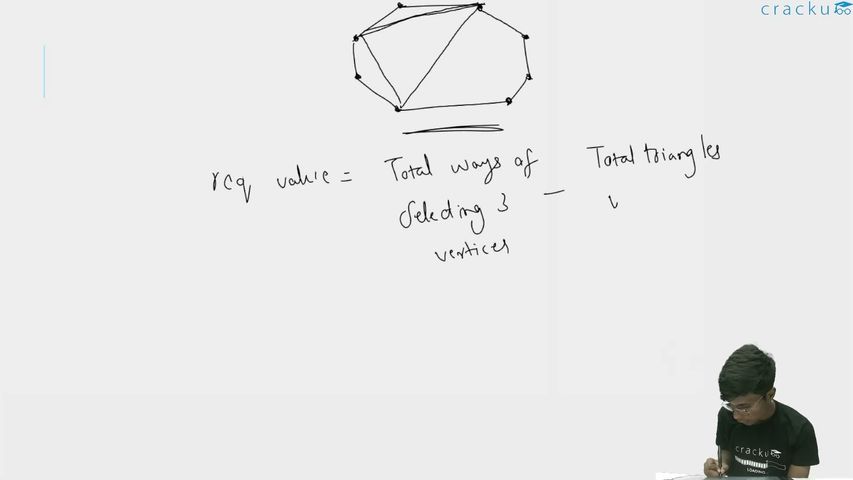
We need to count triangles whose vertices are vertices of a regular octagon, but none of whose sides is a side of the octagon.
A regular octagon has 8 vertices. The total number of triangles formed by choosing any 3 vertices is given by $$\binom{8}{3} = \frac{8!}{3! \times 5!} = \frac{8 \times 7 \times 6}{6} = 56$$.
Using complementary counting, the desired number equals the total number of triangles minus those with at least one side of the octagon.
To count triangles with exactly one side of the octagon, note that the octagon has 8 sides. For each side, the third vertex must not be adjacent to either endpoint of that side, which excludes the two endpoints themselves and their two other neighbors, leaving $$8 - 4 = 4$$ valid choices for the third vertex. Hence there are $$8 \times 4 = 32$$ such triangles.
Triangles with exactly two sides of the octagon occur when the two sides are consecutive, sharing a common vertex, and each such pair of consecutive sides determines exactly one triangle formed by three consecutive vertices. Since there are 8 vertices, there are 8 such pairs, giving $$8$$ triangles.
It is impossible for a triangle to have three sides of the octagon, so that count is $$0$$.
Therefore, the total number of triangles with at least one side of the octagon is $$32 + 8 + 0 = 40$$, and the number of triangles with no side of the octagon is $$56 - 40 = 16$$.
The correct answer is Option 4: 16.
Was this solution helpful?
Click on the Email ☝️ to Watch the Video Solution
Create a FREE account and get:
_1.webp)

Educational materials for JEE preparation

Ask our AI anything

AI can make mistakes. Please verify important information.
AI can make mistakes. Please verify important information.
