
Join Our JEE Preparation Group
Prep with like-minded aspirants; Get access to free daily tests and study material.
Sign in
Please select an account to continue using cracku.in
↓ →
Join Our JEE Preparation Group
Prep with like-minded aspirants; Get access to free daily tests and study material.
If $$z$$ is a complex number, then the number of common roots of the equation $$z^{1985} + z^{100} + 1 = 0$$ and $$z^3 + 2z^2 + 2z + 1 = 0$$, is equal to:
We need common roots of $$z^{1985} + z^{100} + 1 = 0$$ and $$z^3 + 2z^2 + 2z + 1 = 0$$.
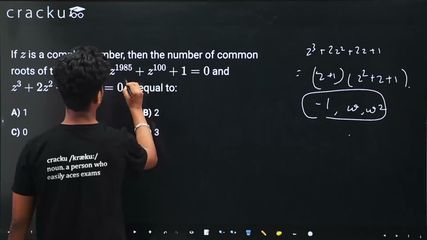
Factor $$z^3 + 2z^2 + 2z + 1 = (z+1)(z^2+z+1) = 0$$.
Roots: $$z = -1$$ and $$z = \omega, \omega^2$$ (cube roots of unity, where $$\omega = e^{2\pi i/3}$$).
Check $$z = -1$$: $$(-1)^{1985} + (-1)^{100} + 1 = -1 + 1 + 1 = 1 \neq 0$$. Not a root.
Check $$z = \omega$$ (where $$\omega^3 = 1$$): $$1985 = 3(661) + 2$$, so $$\omega^{1985} = \omega^2$$. $$100 = 3(33)+1$$, so $$\omega^{100} = \omega$$.
$$\omega^2 + \omega + 1 = 0$$ So $$\omega$$ is a common root.
Similarly $$\omega^2$$: $$(\omega^2)^{1985} = \omega^{3970} = \omega^{3(1323)+1} = \omega$$. $$(\omega^2)^{100} = \omega^{200} = \omega^{3(66)+2} = \omega^2$$.
$$\omega + \omega^2 + 1 = 0$$ . So $$\omega^2$$ is also a common root.
Number of common roots = 2.
The answer is Option (2): $$\boxed{2}$$.
Was this solution helpful?
Click on the Email ☝️ to Watch the Video Solution
Create a FREE account and get:
_1.webp)

Educational materials for JEE preparation

Ask our AI anything

AI can make mistakes. Please verify important information.
AI can make mistakes. Please verify important information.
