
Join Our JEE Preparation Group
Prep with like-minded aspirants; Get access to free daily tests and study material.
Sign in
Please select an account to continue using cracku.in
↓ →
Join Our JEE Preparation Group
Prep with like-minded aspirants; Get access to free daily tests and study material.
If $$(\sqrt{3} + i)^{100} = 2^{99}(p + iq)$$, then $$p$$ and $$q$$ are roots of the equation:
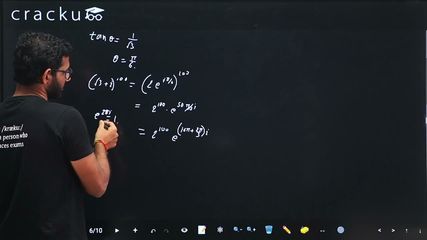
We have the complex number $$\sqrt{3}+i$$. First we express it in polar (modulus-argument) form, because raising a complex number to a high power is easiest when the number is written as $$r(\cos\theta+i\sin\theta)$$.
The modulus is found from the formula $$r=\sqrt{(\text{Re})^{2}+(\text{Im})^{2}}$$. Here $$\text{Re}=\sqrt{3}$$ and $$\text{Im}=1$$, so
$$r=\sqrt{(\sqrt{3})^{2}+1^{2}}=\sqrt{3+1}=2.$$
For the argument we use $$\theta=\tan^{-1}\left(\dfrac{\text{Im}}{\text{Re}}\right)$$. Hence
$$\theta=\tan^{-1}\left(\dfrac{1}{\sqrt{3}}\right)=\tan^{-1}(\tan 30^{\circ})=30^{\circ}=\dfrac{\pi}{6}.$$
So we can write
$$\sqrt{3}+i=2\bigl(\cos\dfrac{\pi}{6}+i\sin\dfrac{\pi}{6}\bigr).$$
Now we are asked to evaluate $$(\sqrt{3}+i)^{100}$$. We will use De Moivre’s theorem, which states:
$$\bigl(r(\cos\theta+i\sin\theta)\bigr)^{n}=r^{\,n}\bigl(\cos n\theta+i\sin n\theta\bigr).$$
Applying the theorem with $$r=2,\;\theta=\dfrac{\pi}{6},\;n=100$$ gives
$$\bigl(\sqrt{3}+i\bigr)^{100}=2^{100}\bigl(\cos(100\cdot\tfrac{\pi}{6})+i\sin(100\cdot\tfrac{\pi}{6})\bigr).$$
The problem statement rewrites this power in the form $$2^{99}(p+iq)$$. To match that form we divide the expression we have by $$2^{99}$$:
$$\bigl(\sqrt{3}+i\bigr)^{100}=2^{99}\Bigl[2\bigl(\cos\tfrac{100\pi}{6}+i\sin\tfrac{100\pi}{6}\bigr)\Bigr]=2^{99}\bigl(p+iq\bigr).$$
Comparing the two brackets, we see directly that
$$p+iq=2\bigl(\cos\tfrac{100\pi}{6}+i\sin\tfrac{100\pi}{6}\bigr).$$
Now we simplify the angle. First compute
$$\dfrac{100\pi}{6}=\dfrac{50\pi}{3}.$$
Next, reduce $$\dfrac{50\pi}{3}$$ to an angle between $$0$$ and $$2\pi$$. Write
$$\dfrac{50\pi}{3}=16\pi+\dfrac{2\pi}{3}.$$
Because multiples of $$2\pi$$ do not change sine or cosine, we subtract $$16\pi=8(2\pi)$$ and keep only the remainder $$\dfrac{2\pi}{3}$$. Therefore
$$\cos\dfrac{50\pi}{3}=\cos\dfrac{2\pi}{3},\qquad\sin\dfrac{50\pi}{3}=\sin\dfrac{2\pi}{3}.$$
We know the exact trigonometric values:
$$\cos\dfrac{2\pi}{3}=-\dfrac12,\qquad\sin\dfrac{2\pi}{3}=\dfrac{\sqrt{3}}{2}.$$
Substituting these into the expression for $$p+iq$$ gives
$$p+iq=2\bigl(-\dfrac12+i\dfrac{\sqrt{3}}{2}\bigr)=-1+i\sqrt{3}.$$
Hence we read off
$$p=-1,\qquad q=\sqrt{3}.$$
We now form the quadratic equation whose roots are exactly $$p$$ and $$q$$. For a quadratic with roots $$\alpha$$ and $$\beta$$, the standard form is
$$x^{2}-(\alpha+\beta)x+\alpha\beta=0.$$
Here $$\alpha=p=-1$$ and $$\beta=q=\sqrt{3}$$, so
Sum of roots $$\alpha+\beta=(-1)+\sqrt{3}=\sqrt{3}-1,$$
Product of roots $$\alpha\beta=(-1)(\sqrt{3})=-\sqrt{3}.$$
Putting these into the standard form gives the required quadratic:
$$x^{2}-(\sqrt{3}-1)x-\sqrt{3}=0.$$
This matches Option D in the list given. Hence, the correct answer is Option 4.
Was this solution helpful?
Click on the Email ☝️ to Watch the Video Solution
Create a FREE account and get:
_1.webp)

Educational materials for JEE preparation

Ask our AI anything

AI can make mistakes. Please verify important information.
AI can make mistakes. Please verify important information.
