
Join Our JEE Preparation Group
Prep with like-minded aspirants; Get access to free daily tests and study material.
Sign in
Please select an account to continue using cracku.in
↓ →
Join Our JEE Preparation Group
Prep with like-minded aspirants; Get access to free daily tests and study material.
Correct statements from the following are:
A. Potassium dichromate is an oxidising agent and it oxidises $$\text{FeSO}_4$$ to $$\text{Fe}_2(\text{SO}_4)_3$$ in acidic medium.
B. Sodium dichromate can be used as primary standard in volumetric estimation.
C. $$\text{CrO}_4^{2-}$$ and $$\text{Cr}_2\text{O}_7^{2-}$$ are interconvertible in aqueous solution by varying the pH of the solution.
D. Cr-O-Cr bond angle in $$\text{Cr}_2\text{O}_7^{2-}$$ is 126°.
choose the correct answer from the options given below
We examine each statement one by one and decide its truth value.
Statement A: Potassium dichromate ($$K_2Cr_2O_7$$) is a strong oxidising agent in acidic medium.
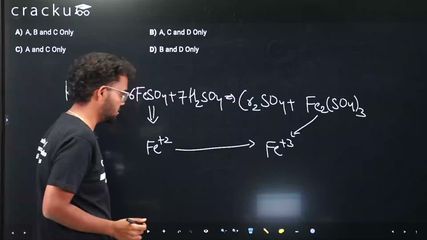
Balanced redox reaction with ferrous sulphate:
$$6\,FeSO_4 + K_2Cr_2O_7 + 7\,H_2SO_4 \rightarrow 3\,Fe_2(SO_4)_3 + K_2SO_4 + Cr_2(SO_4)_3 + 7\,H_2O$$.
$$Fe^{2+}$$ is oxidised to $$Fe^{3+}$$, confirming the statement.
Hence A is correct.
Statement B: A primary standard must be highly pure, stable, non-hygroscopic and of high molar mass. $$Na_2Cr_2O_7 \cdot 2H_2O$$ is distinctly hygroscopic and absorbs moisture, so its exact mass cannot be obtained without error. Therefore it is not suitable as a primary standard.
Hence B is incorrect.
Statement C: In aqueous solution the equilibrium
$$2\,CrO_4^{2-} + 2\,H^+ \;\rightleftharpoons\; Cr_2O_7^{2-} + H_2O$$
shows that increasing $$[H^+]$$ (acidic medium) shifts the equilibrium to the right (dichromate), while adding base shifts it to the left (chromate). Thus chromate and dichromate ions are interconvertible by changing pH.
Hence C is correct.
Statement D: In the $$Cr_2O_7^{2-}$$ ion, two $$CrO_4$$ tetrahedra share one common oxygen. X-ray studies give the $$Cr{-}O{-}Cr$$ (bridging) bond angle as approximately $$126^\circ$$.
Hence D is correct.
Therefore the correct statements are A, C and D.
Option B which is: A, C and D Only
Was this solution helpful?
Click on the Email ☝️ to Watch the Video Solution
Create a FREE account and get:
_1.webp)

Educational materials for JEE preparation

Ask our AI anything

AI can make mistakes. Please verify important information.
AI can make mistakes. Please verify important information.


