
Join Our JEE Preparation Group
Prep with like-minded aspirants; Get access to free daily tests and study material.
Sign in
Please select an account to continue using cracku.in
↓ →
Join Our JEE Preparation Group
Prep with like-minded aspirants; Get access to free daily tests and study material.
The correct statements among the following are:
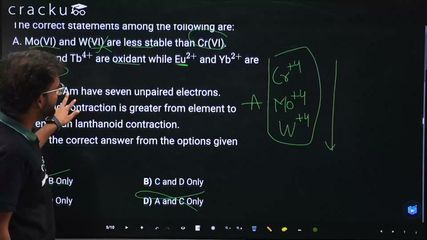
A. Mo(VI) and W(VI) are less stable than Cr(VI).
B. Ce$$^{4+}$$ and Tb$$^{4+}$$ are oxidant while Eu$$^{2+}$$ and Yb$$^{2+}$$ are reductant.
C. Cm and Am have seven unpaired electrons.
D. Actinoid contraction is greater from element to element than lanthanoid contraction.
choose the correct answer from the options given below:
For every statement we first recall the electronic configurations and periodic-trend facts that decide stability, oxidising/reducing behaviour and the magnitude of contraction.
Statement A: “$$\text{Mo(VI)}$$ and $$\text{W(VI)}$$ are less stable than $$\text{Cr(VI)}$$.”
Down group 6 the higher oxidation states become progressively more stable because the larger 4d and 5d orbitals of Mo and W can better accommodate the charge and form stronger $$\pi$$ bonds with oxygen. Thus $$\text{Cr(VI)}$$ compounds (e.g. $$CrO_4^{2-}$$) are powerful oxidants, whereas $$MoO_3$$ and $$WO_3$$ are quite stable and much less oxidising.
Hence statement A is incorrect.
Statement B: “$$Ce^{4+}$$ and $$Tb^{4+}$$ are oxidants while $$Eu^{2+}$$ and $$Yb^{2+}$$ are reductants.”
Lanthanoid ions are most stable in the +3 state. Any ion that lies above +3 tends to gain an electron (acts as an oxidising agent), and any ion below +3 tends to lose an electron (acts as a reducing agent).
• $$Ce^{4+} \rightarrow Ce^{3+}$$ is very favourable ⇒ strong oxidant.
• $$Tb^{4+} \rightarrow Tb^{3+}$$ is also favourable ⇒ oxidant.
• $$Eu^{2+} \rightarrow Eu^{3+}$$ is favourable so $$Eu^{2+}$$ donates an electron ⇒ reductant.
• $$Yb^{2+} \rightarrow Yb^{3+}$$ behaves similarly ⇒ reductant.
Therefore statement B is correct.
Statement C: “Cm and Am have seven unpaired electrons.”
Electronic configurations:
• $$Am (Z=95): [Rn]\,5f^7\,7s^2$$ ⇒ exactly seven 5f electrons, each unpaired ⇒ 7 unpaired electrons.
• $$Cm (Z=96): [Rn]\,5f^7\,6d^1\,7s^2$$ (ground-state) ⇒ the seven 5f electrons plus one unpaired 6d electron ⇒ 8 unpaired electrons.
Since Cm has eight, not seven, unpaired electrons, statement C is incorrect.
Statement D: “Actinoid contraction is greater from element to element than lanthanoid contraction.”
The 5f orbitals in actinoids shield the nuclear charge even less effectively than the 4f orbitals in lanthanoids. Consequently the cumulative decrease in atomic/ionic radii (contraction) per step is larger in the actinoid series. Hence statement D is correct.
Only statements B and D are correct.
Therefore, the correct option is:
Option C which is: B and D Only
Was this solution helpful?
Click on the Email ☝️ to Watch the Video Solution
Create a FREE account and get:
_1.webp)

Educational materials for JEE preparation

Ask our AI anything

AI can make mistakes. Please verify important information.
AI can make mistakes. Please verify important information.


