
Join Our JEE Preparation Group
Prep with like-minded aspirants; Get access to free daily tests and study material.
Sign in
Please select an account to continue using cracku.in
↓ →
Join Our JEE Preparation Group
Prep with like-minded aspirants; Get access to free daily tests and study material.
Given below are two statements:
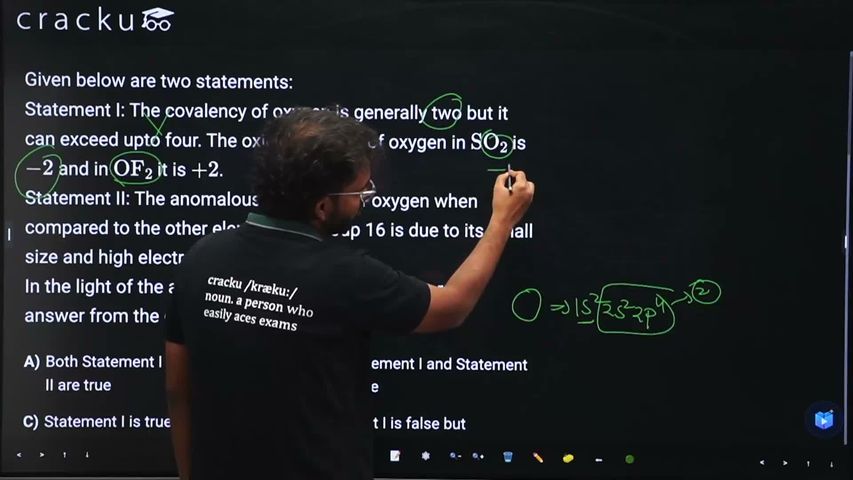
Statement I: The covalency of oxygen is generally two but it can exceed upto four. The oxidation state of oxygen in $$\text{SO}_2$$ is $$-2$$ and in $$\text{OF}_2$$ it is $$+2$$.
Statement II: The anomalous behaviour of oxygen when compared to the other elements of group 16 is due to its small size and high electronegativity.
In the light of the above statements, choose the correct answer from the options given below
The covalency of an element is the actual number of covalent bonds it forms in a stable compound.
Oxygen has the outer-electronic configuration $$1s^2\,2s^2\,2p^4$$. It possesses only two unpaired $$2p$$ electrons, so it can form at most two covalent $$\sigma$$-bonds in the ground or any excited state (no vacant $$d$$-orbitals are available in the $$n = 2$$ shell).
Hence the maximum covalency of oxygen is strictly $$2$$, never $$4$$.
Therefore the first sentence of Statement I is incorrect.
Oxidation state calculations:
• In $$SO_2$$, let the oxidation state of S be $$x$$.
$$x + 2(-2) = 0 \;\Rightarrow\; x = +4$$, so each O is indeed $$-2$$.
• In $$OF_2$$, fluorine is always $$-1$$ (most electronegative).
Let the oxidation state of O be $$y$$.
$$y + 2(-1) = 0 \;\Rightarrow\; y = +2$$.
The oxidation states quoted in Statement I are correct, but because the first sentence is wrong,
Statement I as a whole is false.
Statement II attributes oxygen’s anomalous behaviour (very high electronegativity, ability to form multiple hydrogen bonds, exceptionally high bond dissociation energy of $$O=O$$, etc.) to its very small atomic size and highest electronegativity in Group 16.
So Statement II is true.
Combining the two results:
Statement I is false, while Statement II is true → Option D.
Was this solution helpful?
Click on the Email ☝️ to Watch the Video Solution
Create a FREE account and get:
_1.webp)

Educational materials for JEE preparation

Ask our AI anything

AI can make mistakes. Please verify important information.
AI can make mistakes. Please verify important information.


