Sign in
Please select an account to continue using cracku.in
↓ →
Prep with like-minded aspirants; Get access to free daily tests and study material.
$$M^{2+} + H_2S \to A \text{ (Black precipitate)} + \text{by product}$$
$$A + \text{aqua regia} \to B + NOCl + S + H_2O$$
$$B + KNO_2 + CH_3COOH \to C + \text{by product}$$
Consider the following test for a group-IV cation. The spin-only magnetic moment value of the metal complex C is ______ BM (Nearest integer)
Correct Answer: 0
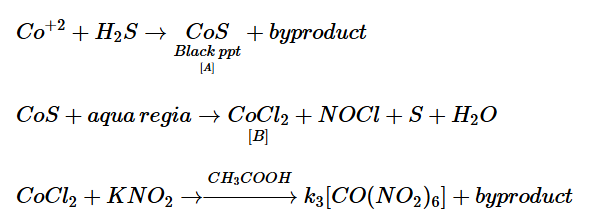
First decide which group-IV cation gives a black sulphide with $$H_2S$$ in basic medium.
MnS is flesh-coloured, ZnS is white, whereas both CoS and NiS are black. Hence $$A$$ can be either $$\text{CoS}$$ or $$\text{NiS}$$.
The sulphide $$A$$ dissolves in aqua regia (a mixture of conc. $$HCl$$ and $$HNO_3$$).
Aqua regia converts a metal sulphide to its chloride: $$\text{MS} + \text{aqua regia} \rightarrow \text{MCl}_2 + NOCl + S + H_2O$$.
Thus $$B$$ is $$\text{MCl}_2$$.
Now examine the confirmatory test: $$B + KNO_2 + CH_3COOH \rightarrow C$$ (brown precipitate).
Only cobalt(II) chloride reacts with excess $$KNO_2$$ in mildly acidic medium (acetic acid) to give potassium hexa-nitrito-cobaltate(III):
$$3\,\text{CoCl}_2 + 6\,KNO_2 + 2\,CH_3COOH \rightarrow 2\,KCl + 2\,CH_3COOK + 3\,K[Co(NO_2)_6]\;(C) + 2\,HCl$$.
Nickel(II) chloride does not give such a precipitate. Therefore
Case 1: $$M^{2+} = Ni^{2+}$$ ⇒ no brown nitrito precipitate (reject).
Case 2: $$M^{2+} = Co^{2+}$$ ⇒ brown precipitate of $$K_3[Co(NO_2)_6]$$ (accept).
Hence
$$M^{2+} = Co^{2+},\; A = CoS,\; B = CoCl_2,\; C = K_3[Co(NO_2)_6]$$.
Determine the spin-only magnetic moment of the complex $$C$$.
In $$K_3[Co(NO_2)_6]$$ the oxidation state of cobalt is +3, so the electronic configuration is $$[Ar]\,3d^6$$.
$$NO_2^-$$ is a strong-field ligand; in an octahedral field it produces a low-spin arrangement:
$$t_{2g}^6\,e_g^0$$ → number of unpaired electrons $$n = 0$$.
The spin-only magnetic moment formula is $$\mu_{\text{spin}} = \sqrt{n(n+2)}\; \text{BM}$$.
Substituting $$n = 0$$ gives $$\mu_{\text{spin}} = 0\; \text{BM}$$.
Therefore, the magnetic moment of complex $$C$$ is 0 BM (nearest integer).
Create a FREE account and get:
Predict your JEE Main percentile, rank & performance in seconds
Educational materials for JEE preparation
Ask our AI anything
AI can make mistakes. Please verify important information.
