
Join Our JEE Preparation Group
Prep with like-minded aspirants; Get access to free daily tests and study material.
Sign in
Please select an account to continue using cracku.in
↓ →
Join Our JEE Preparation Group
Prep with like-minded aspirants; Get access to free daily tests and study material.
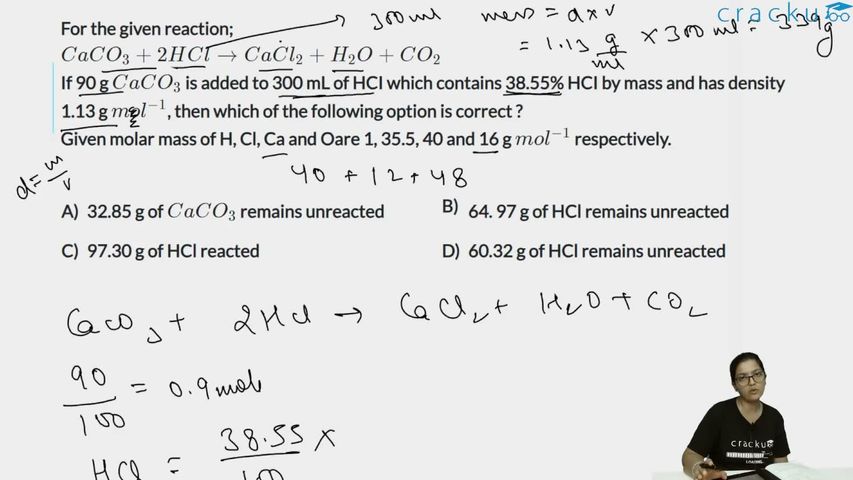
For the given reaction;
$$CaCO_{3}+2HCl\rightarrow CaCl_{2}+H_{2}O+CO_{2}$$
If 90 g $$CaCO_{3}$$ is added to 300 mL of HCI which contains 38.55% HCI by mass and has density 1.13 g $$mol^{-1}$$, then which of the following option is correct ?
Given molar mass of H, Cl, Ca and Oare 1, 35.5, 40 and 16 g $$mol^{-1}$$ respectively.
The reaction is: $$CaCO_{3} + 2HCl \rightarrow CaCl_{2} + H_{2}O + CO_{2}$$
Given:
First, calculate the mass of the HCl solution:
Mass of HCl solution = density × volume = 1.13 g/mL × 300 mL = 339 g
Next, calculate the mass of HCl in the solution:
Mass of HCl = (38.55 / 100) × 339 g = 0.3855 × 339 g
Compute: 0.3855 × 300 = 115.65, 0.3855 × 39 = 15.0345, total = 115.65 + 15.0345 = 130.6845 g
So, mass of HCl = 130.6845 g
Now, find the molar masses:
Molar mass of $$CaCO_{3}$$ = Ca + C + 3O = 40 + 12 + 3×16 = 40 + 12 + 48 = 100 g/mol
Molar mass of HCl = H + Cl = 1 + 35.5 = 36.5 g/mol
Calculate moles of each reactant:
Moles of $$CaCO_{3}$$ = mass / molar mass = 90 g / 100 g/mol = 0.9 mol
Moles of HCl = mass / molar mass = 130.6845 g / 36.5 g/mol ≈ 3.5804 mol
(Calculation: 130.6845 ÷ 36.5 = 3.58039726... ≈ 3.5804 mol)
From the reaction stoichiometry, 1 mol of $$CaCO_{3}$$ requires 2 mol of HCl.
Moles of HCl required for 0.9 mol of $$CaCO_{3}$$ = 2 × 0.9 = 1.8 mol
Since available moles of HCl (3.5804 mol) are greater than required (1.8 mol), HCl is in excess, and $$CaCO_{3}$$ is the limiting reactant.
Thus, $$CaCO_{3}$$ will be completely consumed, and some HCl will remain unreacted.
Calculate the mass of HCl reacted:
Moles of HCl reacted = 1.8 mol
Mass of HCl reacted = moles × molar mass = 1.8 mol × 36.5 g/mol = 65.7 g
Mass of unreacted HCl = total mass of HCl - mass of HCl reacted = 130.6845 g - 65.7 g = 64.9845 g ≈ 64.98 g
Now, evaluate the options:
Thus, option B is correct.
Was this solution helpful?
Click on the Email ☝️ to Watch the Video Solution
Create a FREE account and get:
_1.webp)

Educational materials for JEE preparation

Ask our AI anything

AI can make mistakes. Please verify important information.
AI can make mistakes. Please verify important information.
