
Join Our JEE Preparation Group
Prep with like-minded aspirants; Get access to free daily tests and study material.
Sign in
Please select an account to continue using cracku.in
↓ →
Join Our JEE Preparation Group
Prep with like-minded aspirants; Get access to free daily tests and study material.
Consider the metal complexes $$[Ni(en)_3]^{2+}$$ (A), $$[NiCl_4]^{2-}$$ (B) and $$[Ni(NH_3)_6]^{2+}$$ (C). Choose the CORRECT option by considering the number of unpaired electrons present in (A), (B) and (C) respectively and the order of frequency of absorption
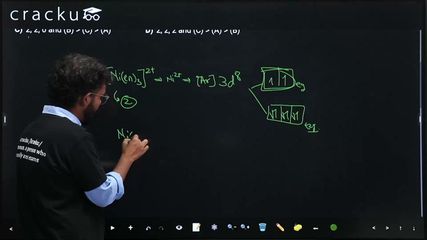
Atomic number of nickel, $$Z = 28$$. Neutral Ni has electronic configuration $$[Ar]\,3d^8\,4s^2$$.
All three complexes contain $$Ni^{2+}$$. Formation of $$Ni^{2+}$$ removes the two $$4s$$ electrons, giving
$$Ni^{2+} : [Ar]\,3d^{8}$$ (i.e. a $$d^{8}$$ system).
Step 1 : Number of unpaired electrons
(A) $$[\text{Ni}(\text{en})_3]^{2-}$$ is octahedral (three bidentate ethylenediamine ligands).
For an octahedral $$d^{8}$$ ion the configuration is $$t_{2g}^{6}\,e_g^{2}$$.
The two $$e_g$$ electrons occupy the two separate $$e_g$$ orbitals (Hund’s rule), giving 2 unpaired electrons.
(B) $$[\text{NiCl}_4]^{2-}$$ is tetrahedral (large chloride ligands). Tetrahedral splitting is the reverse of octahedral and smaller in magnitude, so high-spin is obtained. Electronic distribution: lower $$e$$ set $$e^{4}$$ (paired), higher $$t_2$$ set $$t_2^{4}$$ (four electrons in three orbitals ⇒ 2 unpaired). Hence 2 unpaired electrons.
(C) $$[\text{Ni}(\text{NH}_3)_6]^{2+}$$ is octahedral. As in (A), octahedral $$d^{8}$$ gives $$t_{2g}^{6}\,e_g^{2}$$ with 2 unpaired electrons.
Thus the numbers of unpaired electrons in (A), (B), (C) are 2, 2, 2.
Step 2 : Order of absorption frequency (ν)
The energy absorbed in a $$d \rightarrow d$$ transition equals the crystal-field splitting: $$\Delta = h\nu$$. Higher $$\Delta$$ ⇒ higher frequency (shorter wavelength).
Ligand field strength follows the spectrochemical series:
$$Cl^- \lt NH_3 \lt en$$ (ethylenediamine is a stronger σ-donor and chelating ligand).
Geometry effect: for the same metal & ligand, $$\Delta_{tetra} \approx \tfrac{4}{9}\Delta_{oct}$$, i.e. tetrahedral complexes have much smaller splitting than octahedral ones.
Comparing our complexes:
(A) Octahedral with strong-field en ⇒ largest $$\Delta$$.
(C) Octahedral with medium-field $$NH_3$$ ⇒ intermediate $$\Delta$$.
(B) Tetrahedral with weak-field $$Cl^-$$ ⇒ smallest $$\Delta$$.
Therefore the absorption-frequency order is
$$\nu_{(A)} \gt \nu_{(C)} \gt \nu_{(B)}$$.
Final result : 2, 2, 2 unpaired electrons and absorption frequency order (A) > (C) > (B).
Option A which is: 2, 2, 2 and (A) > (C) > (B)
Was this solution helpful?
Click on the Email ☝️ to Watch the Video Solution
Create a FREE account and get:
_1.webp)

Educational materials for JEE preparation

Ask our AI anything

AI can make mistakes. Please verify important information.
AI can make mistakes. Please verify important information.


