
Join Our JEE Preparation Group
Prep with like-minded aspirants; Get access to free daily tests and study material.
Sign in
Please select an account to continue using cracku.in
↓ →
Join Our JEE Preparation Group
Prep with like-minded aspirants; Get access to free daily tests and study material.
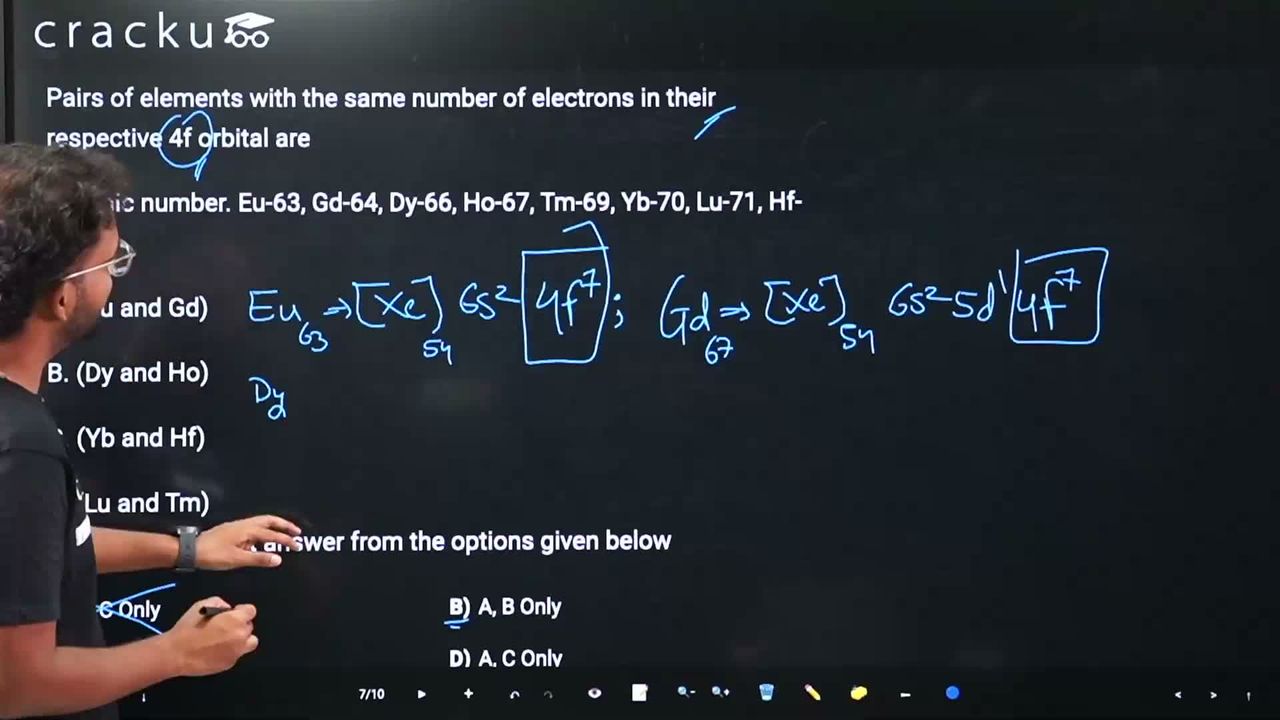
Pairs of elements with the same number of electrons in their respective 4f orbital are
[Atomic number. Eu-63, Gd-64, Dy-66, Ho-67, Tm-69, Yb-70, Lu-71, Hf-72]
A. (Eu and Gd)
B. (Dy and Ho)
C. (Yb and Hf)
D. (Lu and Tm)
choose the correct answer from the options given below
To decide whether two elements have the same number of $$4f$$ electrons we must write their ground-state electronic configurations in terms of the xenon core $$[Xe]$$ followed by the $$4f$$, $$5d$$ and $$6s$$ subshells.
In the lanthanide series (atomic numbers 57-71) electrons are added mainly to the $$4f$$ subshell.
Two useful facts are:
(i) A completely half-filled $$4f$$ subshell contains 7 electrons, i.e. $$4f^7$$.
(ii) A completely filled $$4f$$ subshell contains 14 electrons, i.e. $$4f^{14}$$.
Let us now write the configurations.
Pair ($$Eu, Gd$$)
Europium, $$Z = 63$$: $$[Xe]\;4f^7\,6s^2$$ ⇒ 7 ($$4f$$) electrons.
Gadolinium, $$Z = 64$$: $$[Xe]\;4f^7\,5d^1\,6s^2$$ ⇒ 7 ($$4f$$) electrons.
Both contain 7 $$4f$$ electrons ⇒ SAME.
Pair ($$Dy, Ho$$)
Dysprosium, $$Z = 66$$: $$[Xe]\;4f^{10}\,6s^2$$ ⇒ 10 ($$4f$$) electrons.
Holmium, $$Z = 67$$: $$[Xe]\;4f^{11}\,6s^2$$ ⇒ 11 ($$4f$$) electrons.
Different numbers ⇒ NOT same.
Pair ($$Yb, Hf$$)
Ytterbium, $$Z = 70$$: $$[Xe]\;4f^{14}\,6s^2$$ ⇒ 14 ($$4f$$) electrons.
Hafnium, $$Z = 72$$: $$[Xe]\;4f^{14}\,5d^2\,6s^2$$ ⇒ 14 ($$4f$$) electrons.
Both contain 14 $$4f$$ electrons ⇒ SAME.
Pair ($$Lu, Tm$$)
Thulium, $$Z = 69$$: $$[Xe]\;4f^{13}\,6s^2$$ ⇒ 13 ($$4f$$) electrons.
Lutetium, $$Z = 71$$: $$[Xe]\;4f^{14}\,5d^1\,6s^2$$ ⇒ 14 ($$4f$$) electrons.
Different numbers ⇒ NOT same.
Therefore the pairs having equal numbers of $$4f$$ electrons are:
(A) ($$Eu, Gd$$) and (C) ($$Yb, Hf$$).
Option D $$\longrightarrow\ $$A, C Only
Was this solution helpful?
Click on the Email ☝️ to Watch the Video Solution
Create a FREE account and get:
_1.webp)

Educational materials for JEE preparation

Ask our AI anything

AI can make mistakes. Please verify important information.
AI can make mistakes. Please verify important information.


