
Join Our JEE Preparation Group
Prep with like-minded aspirants; Get access to free daily tests and study material.
Sign in
Please select an account to continue using cracku.in
↓ →
Join Our JEE Preparation Group
Prep with like-minded aspirants; Get access to free daily tests and study material.
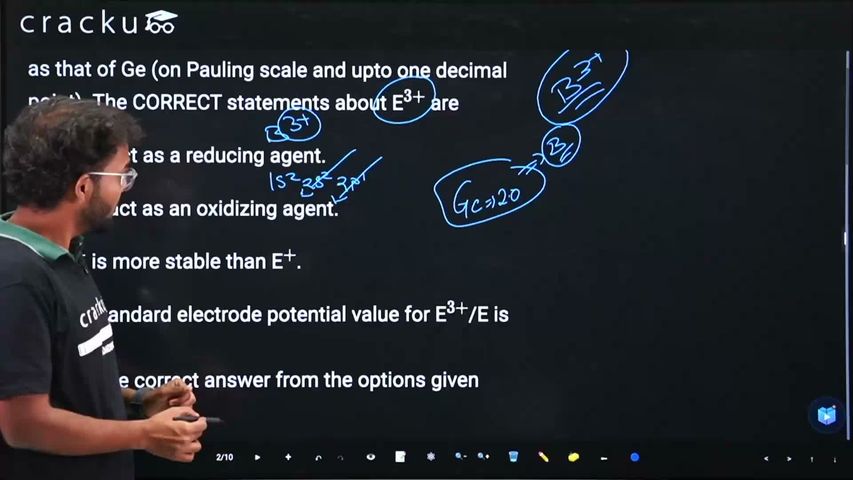
The electronegativity of a group 13 element 'E' is same as that of Ge (on Pauling scale and upto one decimal point). The CORRECT statements about E$$^{3+}$$ are
A. It can act as a reducing agent.
B. It can act as an oxidizing agent.
C. E$$^{3+}$$ is more stable than E$$^+$$.
D. The standard electrode potential value for E$$^{3+}$$/E is positive.
choose the correct answer from the options given below
The Pauling electronegativities (to one decimal place) of the Group 13 elements are: B = 2.0, Al = 1.5, Ga = 1.6, In = 1.7, Tl = 1.8.
Germanium has electronegativity 2.0. Therefore the only Group 13 element whose value matches Ge is boron. Hence $$E = B$$.
We now examine the properties of $$B^{3+}$$ one by one.
Statement A: “$$B^{3+}$$ acts as a reducing agent.”
A species behaves as a reducing agent when it can donate electrons (i.e. get oxidised). $$B^{3+}$$ is already in the highest common oxidation state of boron; it can only gain electrons, not lose more. Thus it cannot act as a reducing agent.
Statement A is false.
Statement B: “$$B^{3+}$$ acts as an oxidising agent.”
An oxidising agent accepts electrons and gets reduced. $$B^{3+}$$ can be reduced to the lower states $$B^{+}$$ or $$B$$ (0). Therefore it behaves as an oxidising agent.
Statement B is true.
Statement C: “$$B^{3+}$$ is more stable than $$B^{+}$$.”
For the lighter Group 13 elements (B, Al, Ga) the inert-pair effect is insignificant, so the +3 state is decidedly the more stable one. The +1 state becomes competitive only for In and dominant for Tl.
Hence $$B^{3+}$$ is indeed more stable than $$B^{+}$$.
Statement C is true.
Statement D: “$$E^{0}(B^{3+}/B)$$ is positive.”
The standard reduction potentials for the series $$M^{3+}+3e^{-}\rightarrow M$$ (Group 13) are: Al = -1.66 V, Ga ≈ -0.53 V, In ≈ -0.34 V, Tl = +1.26 V. Extrapolating to boron (which is even harder to reduce than aluminium because of its very high ionisation energies) gives a value that is still negative. Therefore $$E^{0}(B^{3+}/B)$$ is negative, not positive.
Statement D is false.
Only Statements B and C are correct, so the correct option is
Option B which is: B, C Only.
Was this solution helpful?
Click on the Email ☝️ to Watch the Video Solution
Create a FREE account and get:
_1.webp)

Educational materials for JEE preparation

Ask our AI anything

AI can make mistakes. Please verify important information.
AI can make mistakes. Please verify important information.


