
Join Our JEE Preparation Group
Prep with like-minded aspirants; Get access to free daily tests and study material.
Sign in
Please select an account to continue using cracku.in
↓ →
Join Our JEE Preparation Group
Prep with like-minded aspirants; Get access to free daily tests and study material.
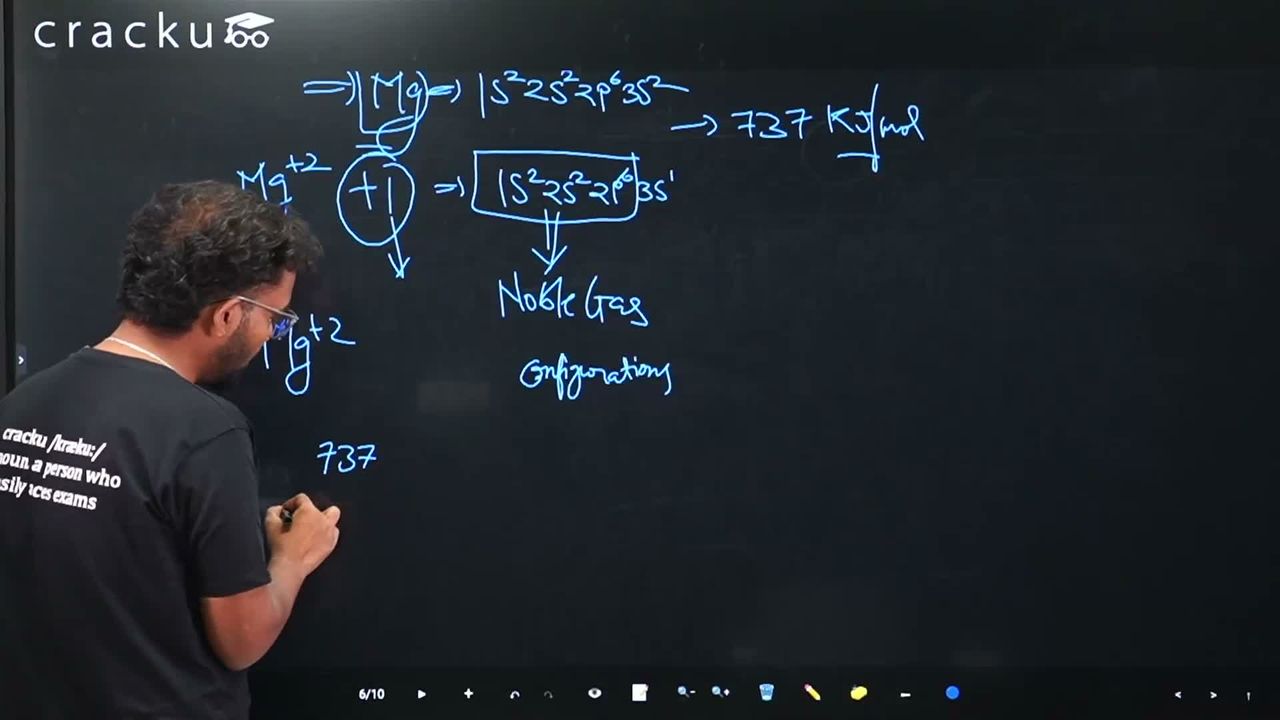
The 1$$^{st}$$ ionization enthalpy for Mg is +737 kJ/mol. The most probable estimated value of the 2$$^{nd}$$ ionization enthalpy of Mg is ______.
The atomic configuration of neutral magnesium is $$1s^2\,2s^2\,2p^6\,3s^2$$.
• First ionization enthalpy ($$\Delta_iH_1$$) removes one $$3s$$ electron:
$$Mg(g) \;\xrightarrow{+\;737\;{\rm kJ\;mol^{-1}}}\; Mg^{+}(g) + e^-$$
• The resulting $$Mg^{+}$$ ion now has the configuration $$1s^2\,2s^2\,2p^6\,3s^1$$.
The next (second) electron to be removed is the remaining $$3s$$ electron, still situated in the outermost $$n=3$$ shell. Because the effective nuclear charge experienced by this electron is higher (one electron fewer while the nuclear charge is unchanged), a larger energy input is needed, but no shell‐change is involved yet.
Hence the second ionization enthalpy ($$\Delta_iH_2$$) must be:
1. Positive (energy has to be supplied).
2. Greater than $$737\;{\rm kJ\;mol^{-1}}$$ but not astronomically large (huge jump occurs only for the third ionization when the noble-gas core begins to ionize).
Among the given choices, only $$+1450\;{\rm kJ\;mol^{-1}}$$ satisfies both conditions:
it is larger than the first ionization enthalpy yet still far below the multi-thousand values typical after the noble-gas core is breached.
Therefore the most probable second ionization enthalpy of magnesium is
Option C $$\longrightarrow\ $$ $$+1450\;{\rm kJ\;mol^{-1}}$$
Was this solution helpful?
Click on the Email ☝️ to Watch the Video Solution
Create a FREE account and get:
_1.webp)

Educational materials for JEE preparation

Ask our AI anything

AI can make mistakes. Please verify important information.
AI can make mistakes. Please verify important information.


