
Join Our JEE Preparation Group
Prep with like-minded aspirants; Get access to free daily tests and study material.
Sign in
Please select an account to continue using cracku.in
↓ →
Join Our JEE Preparation Group
Prep with like-minded aspirants; Get access to free daily tests and study material.
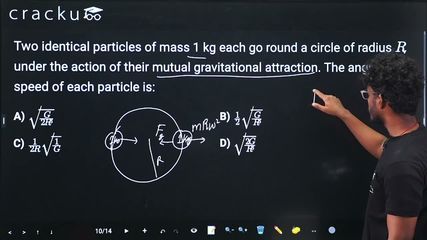
Two identical particles of mass 1 kg each go round a circle of radius $$R$$, under the action of their mutual gravitational attraction. The angular speed of each particle is:
Let us consider the two identical particles, each of mass $$m = 1\text{ kg}$$. Because the particles are identical, their centre of mass lies exactly at the midpoint of the line joining them. We are told that each particle moves in a circle of radius $$R$$ around this midpoint, so the distance between the two particles is twice this radius:
$$d = 2R.$$
First, we write the universal law of gravitation:
Gravitational force between two point masses is $$F = \dfrac{G\,m_1 m_2}{d^2}.$$
Substituting $$m_1 = m_2 = 1\text{ kg}$$ and $$d = 2R$$, we get
$$F = \dfrac{G \,(1)(1)}{(2R)^2} = \dfrac{G}{4R^2}.$$
This gravitational force is the only force acting on each particle, and it points along the line joining the particles, which also passes through the centre of the circular path. Therefore, this same force provides the necessary centripetal force for uniform circular motion.
The formula for centripetal force is
$$F_{\text{centripetal}} = m\,\omega^2\,r,$$
where $$\omega$$ is the angular speed and $$r$$ is the radius of the circular path. For each particle, $$m = 1\text{ kg}$$ and $$r = R$$, so
$$F_{\text{centripetal}} = (1)\,\omega^2\,R = \omega^2 R.$$
Because the gravitational force supplies the required centripetal force, we equate the two:
$$\dfrac{G}{4R^2} = \omega^2 R.$$
We now solve this equation for $$\omega$$ step by step.
First, isolate $$\omega^2$$ by dividing both sides by $$R$$:
$$\omega^2 = \dfrac{G}{4R^2} \cdot \dfrac{1}{R} = \dfrac{G}{4R^3}.$$
Now take the positive square root to obtain $$\omega$$ (angular speed is taken as positive):
$$\omega = \sqrt{\dfrac{G}{4R^3}} = \dfrac{1}{2}\sqrt{\dfrac{G}{R^3}}.$$
This matches Option B.
Hence, the correct answer is Option B.
Was this solution helpful?
Click on the Email ☝️ to Watch the Video Solution
Create a FREE account and get:
_1.webp)

Educational materials for JEE preparation

Ask our AI anything

AI can make mistakes. Please verify important information.
AI can make mistakes. Please verify important information.
