
Join Our JEE Preparation Group
Prep with like-minded aspirants; Get access to free daily tests and study material.
Sign in
Please select an account to continue using cracku.in
↓ →
Join Our JEE Preparation Group
Prep with like-minded aspirants; Get access to free daily tests and study material.
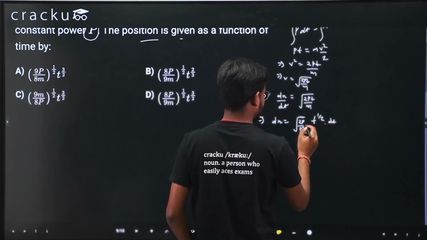
An automobile of mass $$m$$ accelerates starting from the origin and initially at rest, while the engine supplies constant power $$P$$. The position is given as a function of time by:
We begin by recalling the definition of mechanical power. When a force $$F$$ moves an object with instantaneous speed $$v$$, the power delivered is
$$P = F\,v.$$
For the automobile of mass $$m$$, the only horizontal force producing acceleration is the net engine force. Newton’s second law gives
$$F = m\,a = m\,\frac{dv}{dt}.$$
Substituting this value of $$F$$ in the power expression, we get
$$P = \left(m\frac{dv}{dt}\right)v.$$
So
$$m\,v\,\frac{dv}{dt} = P.$$
To separate the variables, multiply both sides by $$dt$$:
$$m\,v\,dv = P\,dt.$$
Now integrate each side. At $$t = 0$$ the car is at rest, so the lower limit for velocity is $$0$$.
$$\int_{0}^{v} m\,v\,dv = \int_{0}^{t} P\,dt.$$
Carry out the integrations:
$$m\left[\frac{v^{2}}{2}\right]_{0}^{v} = P\,[t]_{0}^{t}.$$
So
$$\frac{m\,v^{2}}{2} = P\,t.$$
Solving for $$v^{2}$$ gives
$$v^{2} = \frac{2P}{m}\,t.$$
Taking the positive square root (speed is non-negative), we obtain the velocity as a function of time:
$$v = \sqrt{\frac{2P}{m}}\;t^{1/2}.$$
Next, we use the relationship between velocity and position, namely
$$v = \frac{dx}{dt}.$$
Substituting the expression for $$v$$ just found, we have
$$\frac{dx}{dt} = \sqrt{\frac{2P}{m}}\;t^{1/2}.$$
Separate the variables:
$$dx = \sqrt{\frac{2P}{m}}\;t^{1/2}\,dt.$$
Integrate again, with the initial condition that the car starts from the origin $$x = 0$$ at $$t = 0$$:
$$\int_{0}^{x} dx = \sqrt{\frac{2P}{m}}\int_{0}^{t} t^{1/2}\,dt.$$
The left integral simply yields $$x$$. For the right side, recall the power rule of integration, $$\int t^{n}\,dt = \frac{t^{\,n+1}}{n+1}$$. Here $$n = \tfrac{1}{2}$$, so
$$\int t^{1/2}\,dt = \frac{t^{3/2}}{3/2} = \frac{2}{3}t^{3/2}.$$
Therefore,
$$x = \sqrt{\frac{2P}{m}}\;\left(\frac{2}{3}\,t^{3/2}\right).$$
Simplify the coefficient. The numerical factor becomes $$\frac{2}{3}$$, and under the radical we can combine constants:
$$\frac{2}{3}\sqrt{\frac{2P}{m}} = \sqrt{\frac{4}{9}}\;\sqrt{\frac{2P}{m}} = \sqrt{\frac{8P}{9m}}.$$
Thus the position as a function of time is finally
$$x(t) = \left(\frac{8P}{9m}\right)^{\frac{1}{2}}\,t^{\frac{3}{2}}.$$
This matches Option D.
Hence, the correct answer is Option 4.
Was this solution helpful?
Click on the Email ☝️ to Watch the Video Solution
Create a FREE account and get:
_1.webp)

Educational materials for JEE preparation

Ask our AI anything

AI can make mistakes. Please verify important information.
AI can make mistakes. Please verify important information.
