
Join Our JEE Preparation Group
Prep with like-minded aspirants; Get access to free daily tests and study material.
Sign in
Please select an account to continue using cracku.in
↓ →
Join Our JEE Preparation Group
Prep with like-minded aspirants; Get access to free daily tests and study material.
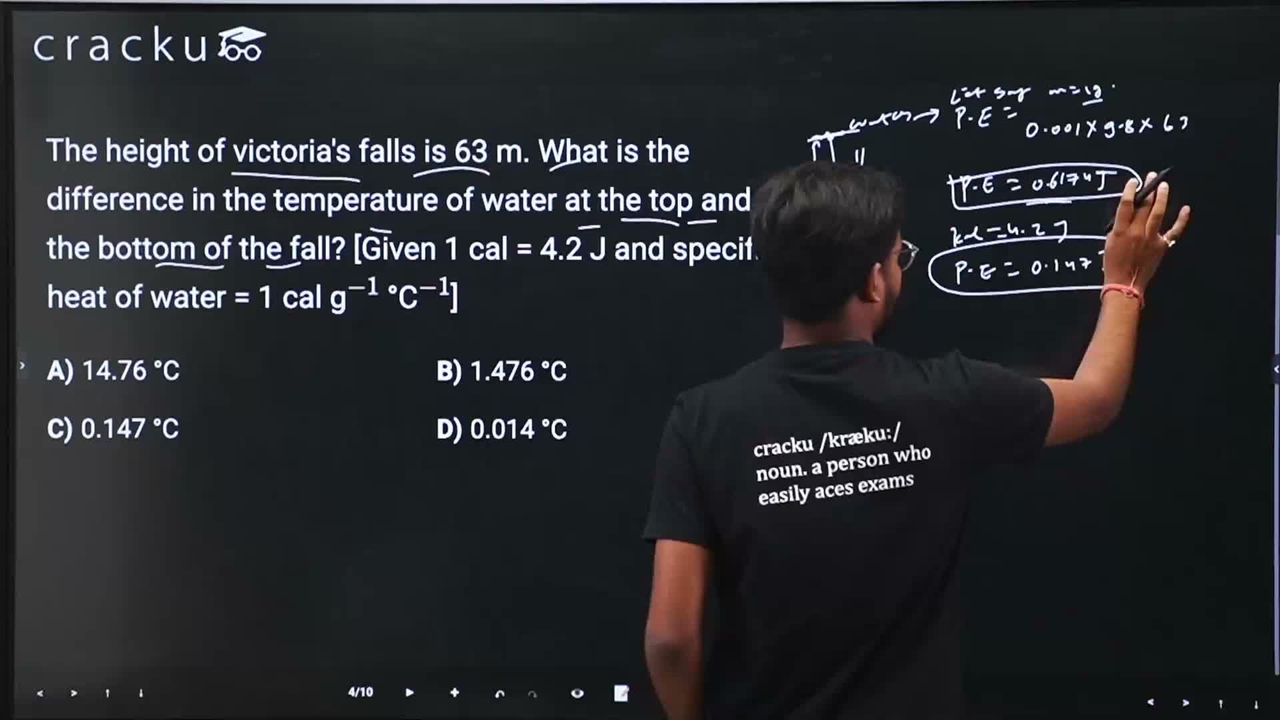
The height of victoria's falls is 63 m. What is the difference in the temperature of water at the top and at the bottom of the fall? [Given 1 cal = 4.2 J and specific heat of water = 1 cal g$$^{-1}$$ °C$$^{-1}$$]
We begin by realising that when water falls from the top of the falls to the bottom, the gravitational potential energy it loses is converted almost entirely into internal (thermal) energy, and this causes its temperature to rise. Hence we equate the loss in potential energy to the heat gained by the water.
The loss of gravitational potential energy for a mass $$m$$ falling through a height $$h$$ is given by the well-known expression
$$\text{Potential energy lost}=mgh,$$
where $$g$$ is the acceleration due to gravity.
We take a convenient mass of water, say $$m=1\ \text{g}$$. To use SI units in the energy calculation we write this as
$$m=1\ \text{g}=0.001\ \text{kg}.$$
The height of Victoria’s Falls is given as
$$h = 63\ \text{m},$$
and we use the standard value
$$g = 9.8\ \text{m s}^{-2}.$$
Substituting these values into the potential-energy formula, we obtain
$$\begin{aligned} \text{Potential energy lost} &= m g h \\ &= (0.001\ \text{kg})(9.8\ \text{m s}^{-2})(63\ \text{m}) \\ &= 0.6174\ \text{J}. \end{aligned}$$
Now, this energy becomes heat $$Q$$ absorbed by the same mass of water. To find the corresponding heat in calories, we recall the conversion factor stated in the question,
$$1\ \text{cal} = 4.2\ \text{J}.$$
Hence
$$\begin{aligned} Q &= \frac{0.6174\ \text{J}}{4.2\ \text{J cal}^{-1}} \\ &= 0.147\ \text{cal}. \end{aligned}$$
Next, we relate this heat to the rise in temperature using the definition of specific heat capacity. For a substance of mass $$m$$, specific heat $$c$$, and temperature change $$\Delta T$$, the heat absorbed is
$$Q = m c \Delta T.$$
The specific heat of water is given as
$$c = 1\text{ cal g}^{-1}\,^{\circ}\text{C}^{-1}$$
and we are still considering $$m = 1\ \text{g}$$ of water. Substituting these values, we get
$$\begin{aligned} 0.147\ \text{cal} &= (1\ \text{g})(1\ \text{cal g}^{-1}\,^{\circ}\text{C}^{-1})\Delta T \\ \Delta T &= 0.147\ ^{\circ}\text{C}. \end{aligned}$$
Thus the water becomes warmer by approximately $$0.147\ ^{\circ}\text{C}$$ between the top and the bottom of the falls.
Hence, the correct answer is Option C.
Click on the Email ☝️ to Watch the Video Solution
Create a FREE account and get:
_1.webp)

Educational materials for JEE preparation

Ask our AI anything

AI can make mistakes. Please verify important information.
AI can make mistakes. Please verify important information.


