
Join Our JEE Preparation Group
Prep with like-minded aspirants; Get access to free daily tests and study material.
Sign in
Please select an account to continue using cracku.in
↓ →
Join Our JEE Preparation Group
Prep with like-minded aspirants; Get access to free daily tests and study material.
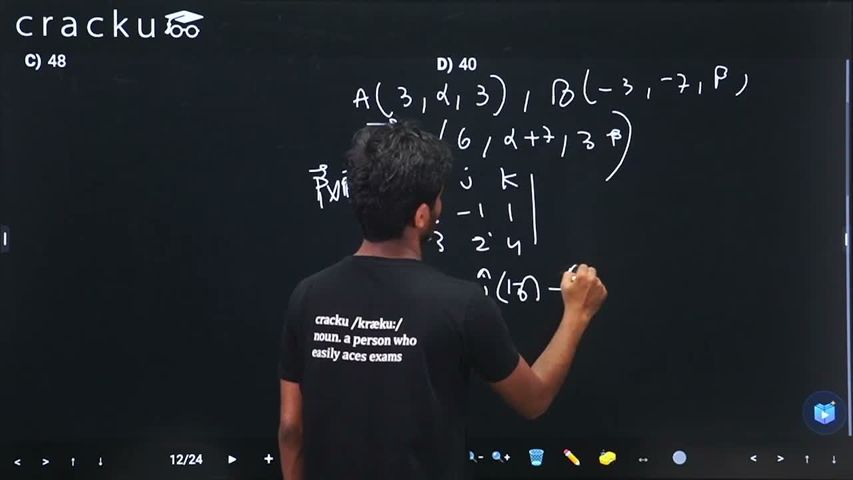
Let the shortest distance between the lines $$\dfrac{x - 3}{3} = \dfrac{y - \alpha}{-1} = \dfrac{z - 3}{1}$$ and $$\dfrac{x + 3}{-3} = \dfrac{y + 7}{2} = \dfrac{z - \beta}{4}$$ be $$3\sqrt{30}$$. Then the positive value of $$5\alpha + \beta$$ is
The first line can be written in vector form as
$$\mathbf{r}= \mathbf{a}_1 + t\,\mathbf{b}_1,$$
where a point on the line is $$\mathbf{a}_1 = (3,\; \alpha,\; 3)$$ and the direction vector is $$\mathbf{b}_1 = \langle 3,\; -1,\; 1\rangle.$$
The second line is
$$\mathbf{r}= \mathbf{a}_2 + s\,\mathbf{b}_2,$$
with $$\mathbf{a}_2 = (-3,\; -7,\; \beta)$$ and $$\mathbf{b}_2 = \langle -3,\; 2,\; 4\rangle.$$
For two skew lines the shortest distance is given by
$$D = \frac{\left| (\mathbf{a}_2-\mathbf{a}_1)\cdot(\mathbf{b}_1 \times \mathbf{b}_2) \right|}{\left| \mathbf{b}_1 \times \mathbf{b}_2 \right|}. \qquad -(1)$$
Compute the cross product $$\mathbf{b}_1 \times \mathbf{b}_2$$:
$$ \begin{vmatrix} \mathbf{i} & \mathbf{j} & \mathbf{k}\\ 3 & -1 & 1\\ -3 & 2 & 4 \end{vmatrix} = \langle (-1)(4)-1(2),\; -(3\cdot 4-1\cdot(-3)),\; 3\cdot 2-(-1)(-3) \rangle = \langle -6,\; -15,\; 3\rangle. $$
Thus $$\mathbf{b}_1 \times \mathbf{b}_2 = \langle -6,\; -15,\; 3\rangle = -3\langle 2,\; 5,\; -1\rangle.$$
Magnitude of this vector:
$$\left| \mathbf{b}_1 \times \mathbf{b}_2 \right|
= 3\sqrt{2^{2}+5^{2}+(-1)^{2}}
= 3\sqrt{30}. \qquad -(2)$$
Vector joining the two given points:
$$(\mathbf{a}_2-\mathbf{a}_1) = \langle -3-3,\; -7-\alpha,\; \beta-3\rangle
= \langle -6,\; -7-\alpha,\; \beta-3\rangle.$$
Now evaluate the scalar triple product in the numerator of (1):
$$ (\mathbf{a}_2-\mathbf{a}_1)$$\cdot$$(\mathbf{b}_1 $$\times$$ \mathbf{b}_2) = \langle -6,\; -7-$$\alpha$$,\; $$\beta$$-3\rangle $$\cdot$$ \langle -6,\; -15,\; 3\rangle $$ $$ = (-6)(-6) + (-7-$$\alpha$$)(-15) + ($$\beta$$-3)(3) $$ $$ = 36 + 15(7+$$\alpha$$) + 3($$\beta$$-3) $$ $$ = 36 + 105 + 15$$\alpha$$ + 3$$\beta$$ - 9 $$ $$ = 132 + 15$$\alpha$$ + 3$$\beta$$. \qquad -(3) $$
Given shortest distance $$D = 3$$\sqrt{30}$$,$$ substitute (2) and (3) into (1):
$$ $$\frac{\left| 132 + 15\alpha + 3\beta \right|}{3\sqrt{30}$$} = 3$$\sqrt{30}$$. $$
Multiply both sides by $$3$$\sqrt{30}$$:$$
$$ $$\left$$| 132 + 15$$\alpha$$ + 3$$\beta$$ $$\right$$| = 9 $$\times$$ 30 = 270. \qquad -(4)$$
Equation (4) gives two possibilities:
$$132 + 15$$\alpha$$ + 3$$\beta$$ = 270
\quad$$\text{or}$$\quad
132 + 15$$\alpha$$ + 3$$\beta$$ = -270.$$
Divide each by $$3$$:
Case 1: $$5$$\alpha + \beta$$ = 46.$$
Case 2: $$5$$\alpha + \beta$$ = -134.$$
The problem asks for the positive value of $$5$$\alpha + \beta$$$$, hence we choose
Case 1: $$5$$\alpha + \beta$$ = 46.$$
Therefore, the required positive value is $$\mathbf{46}$$, which corresponds to Option B.
Was this solution helpful?
Click on the Email ☝️ to Watch the Video Solution
Create a FREE account and get:
_1.webp)

Educational materials for JEE preparation

Ask our AI anything

AI can make mistakes. Please verify important information.
AI can make mistakes. Please verify important information.
