
Join Our JEE Preparation Group
Prep with like-minded aspirants; Get access to free daily tests and study material.
Sign in
Please select an account to continue using cracku.in
↓ →
Join Our JEE Preparation Group
Prep with like-minded aspirants; Get access to free daily tests and study material.
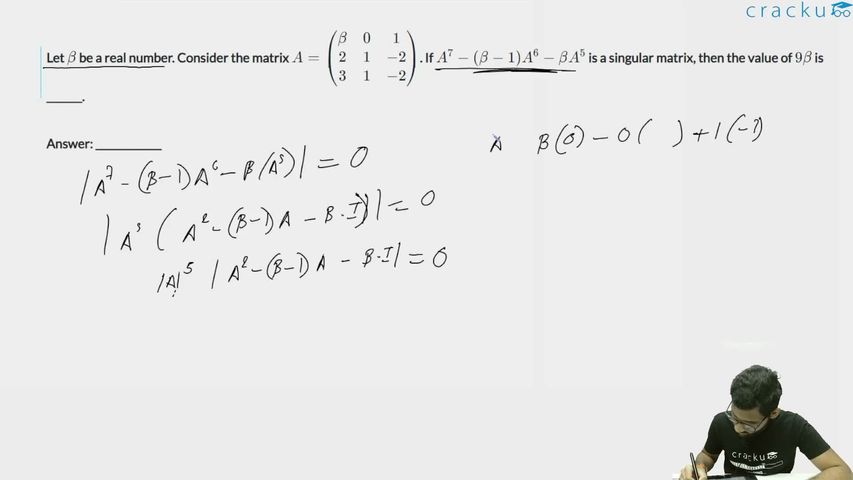
Let $$\beta$$ be a real number. Consider the matrix $$A = \begin{pmatrix} \beta & 0 & 1 \\ 2 & 1 & -2 \\ 3 & 1 & -2 \end{pmatrix}$$. If $$A^7 - (\beta - 1)A^6 - \beta A^5$$ is a singular matrix, then the value of $$9\beta$$ is _______.
Correct Answer: 3
The given matrix is
$$A=\begin{pmatrix}\beta & 0 & 1\\[2pt] 2 & 1 & -2\\[2pt] 3 & 1 & -2\end{pmatrix}\qquad(\beta\in\mathbb{R}).$$
The matrix in the question is
$$M=A^{7}-(\beta-1)A^{6}-\beta A^{5}=A^{5}\Bigl[A^{2}-(\beta-1)A-\beta I\Bigr].$$
Hence
$$\det M=(\det A)^{5}\,\det\!\Bigl[A^{2}-(\beta-1)A-\beta I\Bigr].$$
$$M$$ is singular if and only if at least one of the two determinants on the right‐hand side is zero.
1. Determinant of $$A$$
We first compute $$\det(A-\lambda I)$$ to obtain both $$\det A$$ and the characteristic polynomial.
$$ A-\lambda I=\begin{pmatrix} \beta-\lambda & 0 & 1\\ 2 & 1-\lambda & -2\\ 3 & 1 & -2-\lambda \end{pmatrix}. $$
Expanding along the first row:
$$
\det(A-\lambda I)=(\beta-\lambda)
\det\begin{pmatrix}1-\lambda & -2\\ 1 & -2-\lambda\end{pmatrix}
+1\!\det\begin{pmatrix}2 & 1-\lambda\\ 3 & 1\end{pmatrix}.
$$
$$ \det\begin{pmatrix}1-\lambda & -2\\ 1 & -2-\lambda\end{pmatrix} =(1-\lambda)(-2-\lambda)+2 =-\bigl(1-\lambda\bigr)(2+\lambda)+2 =\lambda+\lambda^{2}. $$
$$ \det\begin{pmatrix}2 & 1-\lambda\\ 3 & 1\end{pmatrix} =2\cdot1-3(1-\lambda)= -1+3\lambda. $$
Therefore
$$
\det(A-\lambda I)=\lambda(1+\lambda)(\beta-\lambda)+3\lambda-1
=-\lambda^{3}+(\beta-1)\lambda^{2}+(\beta+3)\lambda-1.
$$
The constant term gives $$\det A=-1\neq0,$$ which is independent of $$\beta$$. Hence $$\det A^{5}=(-1)^{5}=-1\neq0$$ for every real $$\beta$$. The only possible reason for $$M$$ to be singular is therefore
2. $$\det\!\bigl[A^{2}-(\beta-1)A-\beta I\bigr]=0$$.
Write the characteristic polynomial in monic form (changing sign):
$$
f(\lambda)=\lambda^{3}-(\beta-1)\lambda^{2}-(\beta+3)\lambda+1=0. \qquad -(1)
$$
If $$\lambda$$ is an eigenvalue of $$A$$, then $$\lambda$$ satisfies $$(1)$$.
Define the quadratic polynomial coming from the second factor in $$M$$:
$$
g(\lambda)=\lambda^{2}-(\beta-1)\lambda-\beta. \qquad -(2)
$$
The determinant in question vanishes exactly when some eigenvalue $$\lambda$$ of $$A$$ satisfies both $$(1)$$ and $$(2)$$. Thus we need a common root of the two polynomials. Apply the Euclidean algorithm:
Divide $$f(\lambda)$$ by $$g(\lambda)$$:
Since $$\lambda\cdot g(\lambda)=\lambda^{3}-(\beta-1)\lambda^{2}-\beta\lambda,$$
$$
f(\lambda)-\lambda g(\lambda)=
\bigl[-(\beta+3)\lambda+1\bigr]-\bigl[-\beta\lambda\bigr]
=-3\lambda+1.
$$
The remainder is $$-3\lambda+1$$. A common root must therefore satisfy
$$
-3\lambda+1=0\;\Longrightarrow\;\lambda=\tfrac13. \qquad -(3)
$$
Substituting $$\lambda=\tfrac13$$ into $$(2)$$ gives
$$
\left(\tfrac13\right)^{2}-(\beta-1)\left(\tfrac13\right)-\beta=0,
$$
$$
\frac19-\frac{\beta-1}{3}-\beta=0.
$$
Multiply by 9:
$$
1-3(\beta-1)-9\beta=0\;\Longrightarrow\;4-12\beta=0,
$$
$$
\beta=\frac13.
$$
Hence $$M$$ is singular only for $$\beta=\dfrac13$$, and the asked quantity is
$$
9\beta=9\cdot\frac13=3.
$$
Final Answer: 3
Was this solution helpful?
Click on the Email ☝️ to Watch the Video Solution
Create a FREE account and get:
Educational materials for JEE preparation

Ask our AI anything

AI can make mistakes. Please verify important information.
AI can make mistakes. Please verify important information.

_1.webp)
