
Join Our JEE Preparation Group
Prep with like-minded aspirants; Get access to free daily tests and study material.
Sign in
Please select an account to continue using cracku.in
↓ →
Join Our JEE Preparation Group
Prep with like-minded aspirants; Get access to free daily tests and study material.
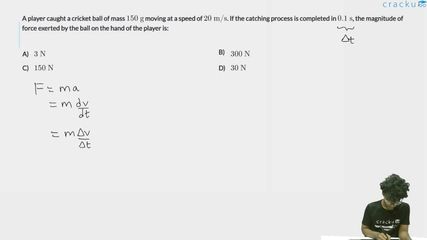
A player caught a cricket ball of mass $$150 \text{ g}$$ moving at a speed of $$20 \text{ m/s}$$. If the catching process is completed in $$0.1 \text{ s}$$, the magnitude of force exerted by the ball on the hand of the player is:
A cricket ball of mass 150 g moving at 20 m/s is caught in 0.1 s. Find the force on the player's hand.
Recall Newton's second law in terms of impulse: $$F = \frac{\Delta p}{\Delta t}$$ where $$\Delta p$$ is the change in momentum and $$\Delta t$$ is the time interval.
The initial momentum is $$p_i = mv = 0.15 \times 20 = 3$$ kg m/s, and the final momentum is $$p_f = 0$$ (ball is brought to rest). Hence, $$|\Delta p| = |p_f - p_i| = 3 \text{ kg m/s}$$.
Substituting into the formula gives $$F = \frac{|\Delta p|}{\Delta t} = \frac{3}{0.1} = 30 \text{ N}$$.
By Newton's third law, the force exerted by the ball on the player's hand equals the force exerted by the hand on the ball.
The correct answer is Option (4): 30 N.
Was this solution helpful?
Click on the Email ☝️ to Watch the Video Solution
Create a FREE account and get:
_1.webp)

Educational materials for JEE preparation

Ask our AI anything

AI can make mistakes. Please verify important information.
AI can make mistakes. Please verify important information.
