
Join Our JEE Preparation Group
Prep with like-minded aspirants; Get access to free daily tests and study material.
Sign in
Please select an account to continue using cracku.in
↓ →
Join Our JEE Preparation Group
Prep with like-minded aspirants; Get access to free daily tests and study material.
$$\lim_{x \to 0} \frac{x\left(e^{(\sqrt{1+x^2+x^4}-1)/x} - 1\right)}{\sqrt{1+x^2+x^4} - 1}$$
We are given the limit:
$$\lim_{x \to 0} \frac{x \left( e^{\frac{\sqrt{1+x^2+x^4}-1}{x}} - 1 \right)}{\sqrt{1+x^2+x^4}-1}$$
Let's define a new variable for the exponent of $$e$$ :
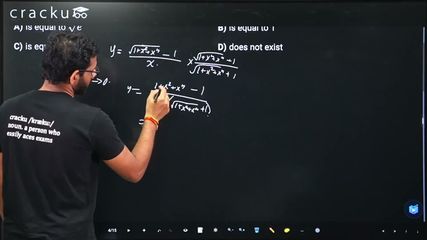
$$y = \frac{\sqrt{1+x^2+x^4}-1}{x}$$
From this substitution, we can express the denominator of our original limit as:
$$x \cdot y = \sqrt{1+x^2+x^4}-1$$
$$x \to 0$$
Before substituting back into the main equation, let's find what $$y$$
approaches as $$x$$ approaches $$0$$ :
$$\lim_{x \to 0} y = \lim_{x \to 0} \frac{\sqrt{1+x^2+x^4}-1}{x}$$
To evaluate this, we multiply the numerator and denominator by the conjugate of the numerator:
$$\lim_{x \to 0} \frac{\left(\sqrt{1+x^2+x^4}-1\right)\left(\sqrt{1+x^2+x^4}+1\right)}{x\left(\sqrt{1+x^2+x^4}+1\right)}$$
Simplify the numerator using the difference of squares
$$(a-b)(a+b) = a^2 - b^2$$ :
$$\lim_{x \to 0} \frac{1+x^2+x^4-1}{x\left(\sqrt{1+x^2+x^4}+1\right)}$$
$$\lim_{x \to 0} \frac{x^2+x^4}{x\left(\sqrt{1+x^2+x^4}+1\right)}$$
Factor out $$x$$
from the numerator to cancel with the denominator:
$$\lim_{x \to 0} \frac{x(x+x^3)}{\sqrt{1+x^2+x^4}+1}$$
Now, substitute $$x = 0$$ :
$$\frac{0+0}{\sqrt{1+0+0}+1} = \frac{0}{2} = 0$$
So, as $$x \to 0$$ , we have $$y \to 0$$.
Now, substitute $$y$$ and $$x \cdot y$$
back into the original limit expression:
$$\lim_{x \to 0} \frac{x \left( e^y - 1 \right)}{x \cdot y}$$
Cancel the $$x$$ terms:
$$\lim_{y \to 0} \frac{e^y - 1}{y}$$
This is a standard fundamental limit in calculus:
$$\lim_{y \to 0} \frac{e^y - 1}{y} = 1$$
The limit evaluates to $$1$$ , which corresponds to Option B.
Was this solution helpful?
Click on the Email ☝️ to Watch the Video Solution
Create a FREE account and get:
_1.webp)

Educational materials for JEE preparation

Ask our AI anything

AI can make mistakes. Please verify important information.
AI can make mistakes. Please verify important information.
