
Join Our JEE Preparation Group
Prep with like-minded aspirants; Get access to free daily tests and study material.
Sign in
Please select an account to continue using cracku.in
↓ →
Join Our JEE Preparation Group
Prep with like-minded aspirants; Get access to free daily tests and study material.
If the line $$y = mx + c$$ is a common tangent to the hyperbola $$\frac{x^2}{100} - \frac{y^2}{64} = 1$$ and the circle $$x^2 + y^2 = 36$$, then which one of the following is true?
First we note that the given line is $$y = mx + c$$. It must touch the circle $$x^2 + y^2 = 36$$ and also touch the hyperbola $$\dfrac{x^2}{100} - \dfrac{y^2}{64} = 1$$. We shall extract one equation for $$c$$ from each tangency condition and then combine them.
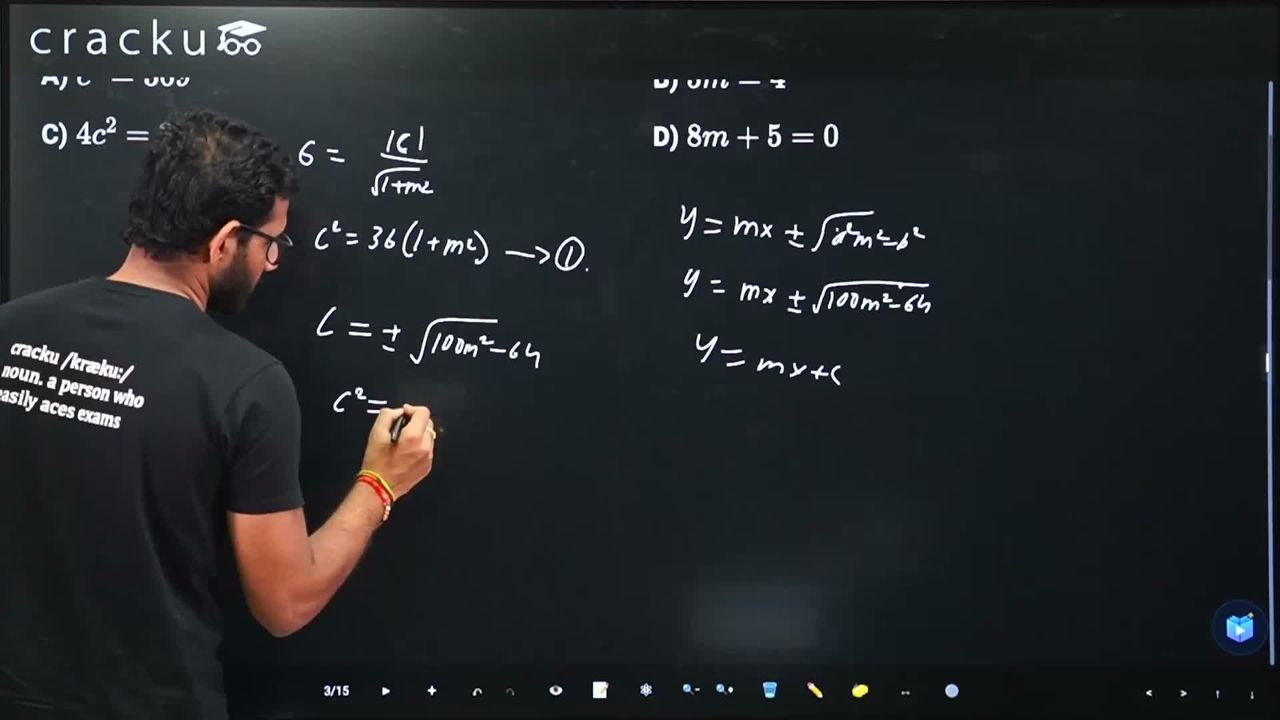
For the circle, its centre is clearly $$(0,\,0)$$ and its radius is $$6$$ because $$x^2 + y^2 = 36$$ can be written as $$x^2 + y^2 = 6^2$$. A straight-line $$y = mx + c$$ touches a circle when the perpendicular distance from the centre to the line equals the radius. The distance of $$(0,\,0)$$ from $$y = mx + c$$ is
$$ \frac{|c|}{\sqrt{1 + m^{2}}}. $$
Setting this distance equal to the radius $$6$$, we have
$$ \frac{|c|}{\sqrt{1+m^{2}}}=6 \quad\Longrightarrow\quad c^{2}=36\,(1+m^{2}). \quad -(1) $$
Now we handle the hyperbola. For a rectangular hyperbola $$\dfrac{x^2}{a^2}-\dfrac{y^2}{b^2}=1$$, a straight-line with slope $$m$$ is a tangent precisely when it can be written as
$$ y = mx \pm \sqrt{a^{2}m^{2}-b^{2}}. $$
Comparing with $$y = mx + c$$, we identify
$$ c=\pm\sqrt{a^{2}m^{2}-b^{2}} \quad\Longrightarrow\quad c^{2}=a^{2}m^{2}-b^{2}. \quad -(2) $$
For our hyperbola we have $$a^{2}=100$$ and $$b^{2}=64$$, so (2) becomes
$$ c^{2}=100m^{2}-64. \quad -(2') $$
Since the very same $$c$$ must satisfy both (1) and (2′), we equate the right-hand sides:
$$ 36\,(1+m^{2}) = 100m^{2}-64. $$
Expanding the left side and then moving every term to one side, we get
$$ 36 + 36m^{2} = 100m^{2}-64 \\ 36 + 36m^{2} - 100m^{2} + 64 = 0 \\ 100 - 64m^{2} = 0. $$
Re-arranging gives
$$ 64m^{2}=100 \quad\Longrightarrow\quad m^{2}=\frac{100}{64}=\frac{25}{16}. $$
Thus $$m=\pm\dfrac{5}{4}$$. Although the sign of $$m$$ is fixed by the particular tangent chosen, any relation we derive for $$c$$ will involve only $$m^{2}$$, so the sign is immaterial for the present purpose.
We now substitute $$m^{2}=\dfrac{25}{16}$$ into (2′) to obtain $$c^{2}$$:
$$ c^{2}=100\left(\frac{25}{16}\right)-64 =\frac{2500}{16}-\frac{1024}{16} =\frac{1476}{16} =\frac{369}{4}. $$
Multiplying both sides by $$4$$ gives the neat relation
$$ 4c^{2}=369. $$
This coincides exactly with Option C.
Hence, the correct answer is Option C.
Was this solution helpful?
Click on the Email ☝️ to Watch the Video Solution
Create a FREE account and get:
_1.webp)

Educational materials for JEE preparation

Ask our AI anything

AI can make mistakes. Please verify important information.
AI can make mistakes. Please verify important information.
