
Join Our JEE Preparation Group
Prep with like-minded aspirants; Get access to free daily tests and study material.
Sign in
Please select an account to continue using cracku.in
↓ →
Join Our JEE Preparation Group
Prep with like-minded aspirants; Get access to free daily tests and study material.
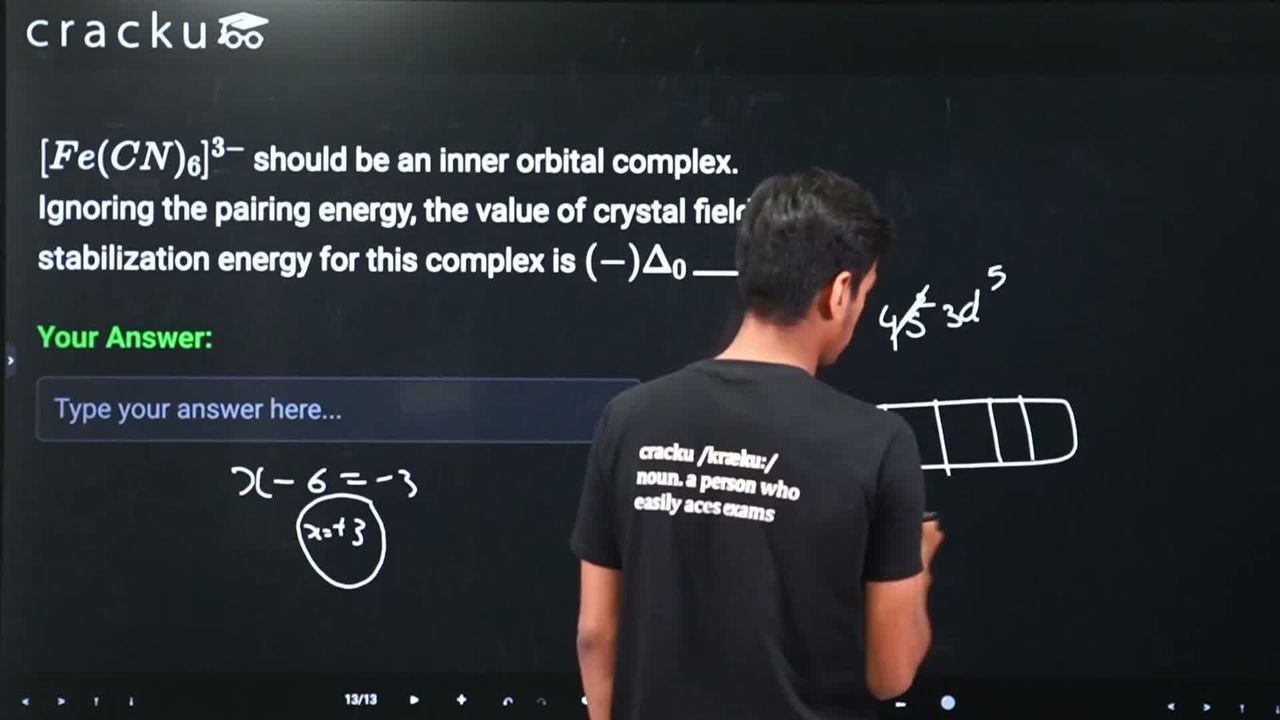
$$[Fe(CN)_6]^{3-}$$ should be an inner orbital complex. Ignoring the pairing energy, the value of crystal field stabilization energy for this complex is $$(-) \Delta_0$$ _____ .
Correct Answer: 2
We are given the complex ion $$[Fe(CN)_6]^{3-}$$ and told it is an inner orbital complex. We need to find the crystal field stabilization energy (CFSE) in terms of $$\Delta_0$$.
We note that in $$[Fe(CN)_6]^{3-}$$, iron is in the $$+3$$ oxidation state. The electronic configuration of $$Fe^{3+}$$ is $$[Ar]\,3d^5$$, so we have 5 d-electrons to place.
Now, $$CN^-$$ is a strong-field ligand, which means it causes a large crystal field splitting. In an octahedral strong-field environment, the electrons preferentially fill the lower-energy $$t_{2g}$$ orbitals before occupying the higher-energy $$e_g$$ orbitals. Since we are told to ignore pairing energy, we place all 5 electrons in the $$t_{2g}$$ set, giving the configuration $$t_{2g}^5\,e_g^0$$.
We recall that each electron in $$t_{2g}$$ contributes $$-0.4\,\Delta_0$$ and each electron in $$e_g$$ contributes $$+0.6\,\Delta_0$$ to the CFSE. Hence the CFSE is $$5 \times (-0.4\,\Delta_0) + 0 \times (0.6\,\Delta_0) = -2.0\,\Delta_0$$.
Since the question states the CFSE is $$(-)\Delta_0 \times \underline{\hspace{1cm}}$$, the blank is the magnitude coefficient. Hence, the correct answer is 2.
Was this solution helpful?
Click on the Email ☝️ to Watch the Video Solution
Create a FREE account and get:
_1.webp)

Educational materials for JEE preparation

Ask our AI anything

AI can make mistakes. Please verify important information.
AI can make mistakes. Please verify important information.
