
Join Our JEE Preparation Group
Prep with like-minded aspirants; Get access to free daily tests and study material.
Sign in
Please select an account to continue using cracku.in
↓ →
Join Our JEE Preparation Group
Prep with like-minded aspirants; Get access to free daily tests and study material.
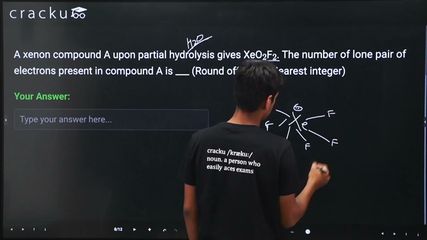
A xenon compound A upon partial hydrolysis gives XeO$$_2$$F$$_2$$. The number of lone pair of electrons present in compound A is ___ (Round off to the Nearest integer)
Correct Answer: 19
The compound A undergoes partial hydrolysis to give $$\text{XeO}_2\text{F}_2$$. The xenon compound that gives $$\text{XeO}_2\text{F}_2$$ on partial hydrolysis is $$\text{XeF}_6$$, since $$\text{XeF}_6 + 2\text{H}_2\text{O} \to \text{XeO}_2\text{F}_2 + 4\text{HF}$$. So compound A is $$\text{XeF}_6$$.
Now we count the total number of lone pairs in $$\text{XeF}_6$$. Each fluorine atom has 7 valence electrons; one is used in bonding to Xe, leaving 6 non-bonding electrons, i.e., 3 lone pairs per F atom. With 6 fluorine atoms, that gives $$6 \times 3 = 18$$ lone pairs from fluorine.
For the central xenon atom in $$\text{XeF}_6$$: Xe has 8 valence electrons, 6 are used in bonding with the six F atoms, leaving 2 non-bonding electrons, which is 1 lone pair on Xe.
The total number of lone pairs in $$\text{XeF}_6$$ is $$18 + 1 = 19$$.
Was this solution helpful?
Click on the Email ☝️ to Watch the Video Solution
Create a FREE account and get:
_1.webp)

Educational materials for JEE preparation

Ask our AI anything

AI can make mistakes. Please verify important information.
AI can make mistakes. Please verify important information.
