
Join Our JEE Preparation Group
Prep with like-minded aspirants; Get access to free daily tests and study material.
Sign in
Please select an account to continue using cracku.in
↓ →
Join Our JEE Preparation Group
Prep with like-minded aspirants; Get access to free daily tests and study material.
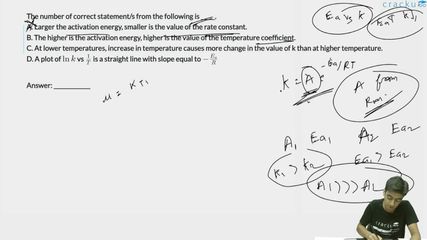
The number of correct statement/s from the following is _____.
A. Larger the activation energy, smaller is the value of the rate constant.
B. The higher is the activation energy, higher is the value of the temperature coefficient.
C. At lower temperatures, increase in temperature causes more change in the value of k than at higher temperature.
D. A plot of $$\ln k$$ vs $$\frac{1}{T}$$ is a straight line with slope equal to $$-\frac{E_a}{R}$$
Correct Answer: 3
The Arrhenius equation relates the rate constant $$k$$ to temperature $$T$$ as
$$k = A\,\exp\!\left(-\frac{E_a}{RT}\right)$$
where $$A$$ is the pre-exponential factor, $$E_a$$ is the activation energy and $$R$$ is the gas constant.
Case A:
For two reactions carried out at the same temperature, a larger $$E_a$$ will indeed make the exponential term smaller; however, the rate constant also depends on $$A$$, which itself varies widely from one reaction to another. If reaction 1 has a much larger $$A$$ than reaction 2, it may still have a larger $$k$$ even though $$E_{a1} \gt E_{a2}$$. Hence the statement “Larger the activation energy, smaller is the value of the rate constant” is not universally valid.
Statement A is incorrect.
Case B:
The temperature coefficient $$\mu$$ is the ratio of rate constants at temperatures differing by $$10\,^{\circ}\!{\rm C}$$ (or $$10\,$$K):
$$\mu = \frac{k_{T+10}}{k_T}$$
Using the Arrhenius form,
$$\mu = \exp\!\Bigg[-\frac{E_a}{R}\Bigg(\frac{1}{T+10}-\frac{1}{T}\Bigg)\Bigg]$$
$$\;=\exp\!\Bigg(\frac{10\,E_a}{R\,T\,(T+10)}\Bigg)$$
Because the exponent is directly proportional to $$E_a$$, a larger activation energy makes $$\mu$$ larger.
Statement B is correct.
Case C:
The sensitivity of $$k$$ to temperature is obtained by differentiating $$\ln k$$:
$$\frac{d(\ln k)}{dT}=\frac{E_a}{R\,T^{2}}$$ $$-(1)$$
Equation $$(1)$$ shows that the fractional change in $$k$$ varies as $$1/T^{2}$$. Thus, for a fixed rise in temperature, the fractional (percentage) increase in $$k$$ is larger at lower temperatures than at higher temperatures.
Statement C is correct.
Case D:
Re-writing the Arrhenius equation:
$$\ln k = \ln A - \frac{E_a}{R}\left(\frac{1}{T}\right)$$
When $$\ln k$$ is plotted against $$1/T$$, the graph is a straight line whose slope is
$$\text{slope}= -\frac{E_a}{R}$$
which matches the statement precisely.
Statement D is correct.
Only Statements B, C and D are correct. Hence, the number of correct statements is 3.
Was this solution helpful?
Click on the Email ☝️ to Watch the Video Solution
Create a FREE account and get:
_1.webp)

Educational materials for JEE preparation

Ask our AI anything

AI can make mistakes. Please verify important information.
AI can make mistakes. Please verify important information.
