
Join Our JEE Preparation Group
Prep with like-minded aspirants; Get access to free daily tests and study material.
Sign in
Please select an account to continue using cracku.in
↓ →
Join Our JEE Preparation Group
Prep with like-minded aspirants; Get access to free daily tests and study material.
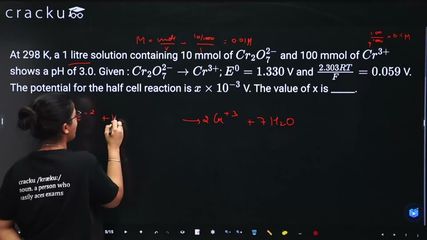
At 298 K, a 1 litre solution containing 10 mmol of $$Cr_2O_7^{2-}$$ and 100 mmol of $$Cr^{3+}$$ shows a pH of 3.0. Given : $$Cr_2O_7^{2-} \to Cr^{3+}$$; $$E^0 = 1.330$$ V and $$\frac{2.303RT}{F} = 0.059$$ V. The potential for the half cell reaction is $$x \times 10^{-3}$$ V. The value of x is _____.
Correct Answer: 917
We need to find the electrode potential for the half-cell reaction $$Cr_2O_7^{2-} \to Cr^{3+}$$. The balanced half-cell reaction is $$Cr_2O_7^{2-} + 14H^+ + 6e^- \to 2Cr^{3+} + 7H_2O$$.
Applying the Nernst equation, $$E = E^0 - \frac{0.059}{n}\log\frac{[Cr^{3+}]^2}{[Cr_2O_7^{2-}][H^+]^{14}}$$, and inserting the values [Cr_2O_7^{2-}] = 10 × 10^{-3} M = 0.01 M, [Cr^{3+}] = 100 × 10^{-3} M = 0.1 M, pH = 3.0 so [H^+] = 10^{-3} M, E^0 = 1.330 V, and n = 6, one computes the logarithmic term as follows.
$$\log\frac{[Cr^{3+}]^2}{[Cr_2O_7^{2-}][H^+]^{14}} = \log\frac{(0.1)^2}{(0.01)(10^{-3})^{14}} = \log\frac{10^{-2}}{10^{-2} \times 10^{-42}} = \log\frac{10^{-2}}{10^{-44}} = \log 10^{42} = 42.$$
Substituting into the Nernst equation gives $$E = 1.330 - \frac{0.059}{6} \times 42 = 1.330 - 0.059 \times 7 = 1.330 - 0.413 = 0.917 \text{ V},$$ so that $$E = 917 \times 10^{-3} \text{ V}$$ and hence $$x = 917$$.
Was this solution helpful?
Click on the Email ☝️ to Watch the Video Solution
Create a FREE account and get:
_1.webp)

Educational materials for JEE preparation

Ask our AI anything

AI can make mistakes. Please verify important information.
AI can make mistakes. Please verify important information.
