
Join Our JEE Preparation Group
Prep with like-minded aspirants; Get access to free daily tests and study material.
Sign in
Please select an account to continue using cracku.in
↓ →
Join Our JEE Preparation Group
Prep with like-minded aspirants; Get access to free daily tests and study material.
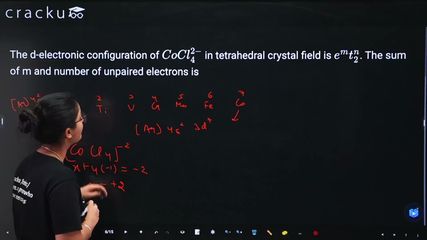
The d-electronic configuration of $$CoCl_4^{2-}$$ in tetrahedral crystal field is $$e^m t_2^n$$. The sum of m and number of unpaired electrons is
Correct Answer: 7
We need to find the d-electronic configuration of $$CoCl_4^{2-}$$ in a tetrahedral crystal field. The oxidation state of Co in $$CoCl_4^{2-}$$ can be determined from $$x + 4(-1) = -2$$, giving $$x = +2$$. Therefore, $$Co^{2+}$$ has the electronic configuration: $$[Ar]3d^7$$.
In a tetrahedral field, the d-orbitals split into two sets: $$e$$ (lower energy), consisting of $$d_{z^2}, d_{x^2-y^2}$$ (2 orbitals), and $$t_2$$ (higher energy), consisting of $$d_{xy}, d_{xz}, d_{yz}$$ (3 orbitals).
Because $$CoCl_4^{2-}$$ contains weak field ligands ($$Cl^-$$), it is a high spin complex. Distributing the seven d-electrons in this high spin tetrahedral configuration gives: $$e$$ can accommodate up to 4 electrons (2 orbitals × 2), and $$t_2$$ can accommodate up to 6 electrons (3 orbitals × 2). Filling accordingly yields $$e^4 t_2^3$$, so $$m = 4$$ and $$n = 3$$.
The number of unpaired electrons is determined from the occupancy: in $$e^4$$ both orbitals are fully paired, contributing 0 unpaired electrons, while in $$t_2^3$$ each of the three orbitals has one electron, contributing 3 unpaired electrons. Thus the complex has 3 unpaired electrons.
The sum of $$m$$ and the number of unpaired electrons is $$4 + 3 = 7$$.
The answer is 7.
Was this solution helpful?
Click on the Email ☝️ to Watch the Video Solution
Create a FREE account and get:
_1.webp)

Educational materials for JEE preparation

Ask our AI anything

AI can make mistakes. Please verify important information.
AI can make mistakes. Please verify important information.
