
Join Our JEE Preparation Group
Prep with like-minded aspirants; Get access to free daily tests and study material.
Sign in
Please select an account to continue using cracku.in
↓ →
Join Our JEE Preparation Group
Prep with like-minded aspirants; Get access to free daily tests and study material.
The length of the minor axis (along y-axis) of an ellipse in the standard form is $$\frac{4}{\sqrt{3}}$$. If this ellipse touches the line $$x + 6y = 8$$ then its eccentricity is:
We begin with the standard form of an ellipse whose centre is at the origin and whose major axis lies along the x-axis:
$$\frac{x^{2}}{a^{2}}+\frac{y^{2}}{b^{2}}=1,\qquad a>b>0.$$
The minor axis is along the y-axis and its total length is $$2b.$$ We are told that this length equals $$\dfrac{4}{\sqrt{3}},$$ so
$$2b=\frac{4}{\sqrt{3}}\;\Longrightarrow\;b=\frac{2}{\sqrt{3}}.$$
Next, the line $$x+6y=8$$ is tangent to the ellipse. To use the tangent condition, we first rewrite the line in slope-intercept form:
$$x+6y=8\;\Longrightarrow\;6y=-x+8\;\Longrightarrow\;y=-\frac{1}{6}x+\frac{4}{3}.$$
Thus the slope is $$m=-\dfrac{1}{6}$$ and the y-intercept is $$c=\dfrac{4}{3}.$$
The well-known tangent condition for an ellipse $$\dfrac{x^{2}}{a^{2}}+\dfrac{y^{2}}{b^{2}}=1$$ says:
For a line of the form $$y=mx+c$$ to touch the ellipse, we must have $$c^{2}=a^{2}m^{2}+b^{2}.$$
Substituting $$m=-\dfrac{1}{6},\;c=\dfrac{4}{3},\;b=\dfrac{2}{\sqrt{3}},$$ we get
$$\left(\frac{4}{3}\right)^{2}=a^{2}\left(-\frac{1}{6}\right)^{2}+\left(\frac{2}{\sqrt{3}}\right)^{2}.$$
Working out each term:
$$\frac{16}{9}=a^{2}\left(\frac{1}{36}\right)+\frac{4}{3}.$$
Now we isolate the term containing $$a^{2}$$:
$$\frac{16}{9}-\frac{4}{3}=a^{2}\left(\frac{1}{36}\right).$$
Because $$\frac{4}{3}=\frac{12}{9},$$ we have
$$\frac{16}{9}-\frac{12}{9}=\frac{4}{9}=\frac{a^{2}}{36}.$$
Multiplying both sides by $$36$$ gives
$$a^{2}=36\left(\frac{4}{9}\right)=4\times4=16.$$
So $$a=4.$$
The eccentricity $$e$$ of an ellipse with major axis along the x-axis is defined by the relation
$$e^{2}=1-\frac{b^{2}}{a^{2}}.$$
Substituting $$a^{2}=16$$ and $$b^{2}=\left(\frac{2}{\sqrt{3}}\right)^{2}=\frac{4}{3},$$ we obtain
$$e^{2}=1-\frac{\dfrac{4}{3}}{16}=1-\frac{4}{48}=1-\frac{1}{12}=\frac{11}{12}.$$
Taking the positive square root (since eccentricity is positive),
$$e=\sqrt{\frac{11}{12}}=\frac{\sqrt{11}}{\sqrt{12}}=\frac{\sqrt{11}}{2\sqrt{3}}=\frac{1}{2}\sqrt{\frac{11}{3}}.$$
Hence, the correct answer is Option A.
Was this solution helpful?
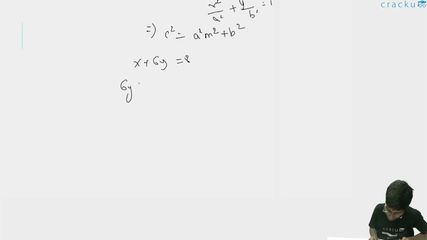
Click on the Email ☝️ to Watch the Video Solution
Create a FREE account and get:
_1.webp)

Educational materials for JEE preparation

Ask our AI anything

AI can make mistakes. Please verify important information.
AI can make mistakes. Please verify important information.
